Environment

Environment

Friday, August 28, 2020

Canales: Dutch people do waterworks

When it rains here it pours, as you obviously will have read in the past, *here*. Yes you have.

The Dyke

Much of the trouble is due to a barranco that should drain away rainwater from the hills, via a terraced campo behind us. Gaps in the walls surrounding those campos drain the water to the next terrace. However, the upper campo has a collapsed wall, so quite a lot of water drains onto the road there, eventually ending up at our entrance. 

We asked the nephew of the owner to close the gap, as he’s into the business of moving earth with digging machines. He said "it's my uncle’s land!". We knew that, and he’s living in Barcelona (really).

We asked him to move some earth against the gap if he had a machine here. He said yes, but nothing happened, even when his diggers were here and I asked again. 

Also, officially, asked the ayuntamiento to do something about it. No reply. Nada. 

Okay, be that way. So, we put up a dyke:


3 Drains

Next step: we made 3 drains across the road, draining water away to the side. Many roads here have concrete channels across the road with a metal grid, to get rid of water:


Drain 1 of 3

We made drain nr. 1 at the entrance of the property, draining away into the canal we had dug:


Spot the nice reflectors? In Spain the right side has orange reflectors, white on the left. NL has red reflectors right.

Drain 2 of 3

In the middle of our bypass canal number two:


Drain 3 of 3

And finally canal nr. 3:


Channel and overflow

And, finally, deepen the existing draining channel in our land to the overflow opening in our lowest wall:


The rains may come!

hm, careful what you wish for now.

Thursday, August 27, 2020

Cave: a mystery! Do we have a ghost?

 As you can see we seem to have a ghost in our cellar, and he’s not happy.


Engineer Jansen discovered this by fingering some loose stones, and even taking one out, worried about the state of the wall. To his surprise there was nothing behind the removed stone. More stones were loose, and quickly removed:


It could be the long lost tunnel to Kirrin Island! 

But no, it is not a tunnel. Our cellar has a black hole in it! 

The black is soot, as we soon found out, having it on hands and clothes. 

Soot? From fire? 
Did they have a fire in the cellar? 
Is there a chimney? (No, I think, at least not any more.) 


What on earth do you use a fire in a cellar for? Asked the question in the facebook forum for Spanish Molinos, ACEM - Asociación para la Conservación y Estudio de los Molinos but so far no answer.

As far as I know this cellar was not for storage, but there were parts of the machinery here. Cogs and belts and wheels. Maybe they needed a bit of fire for softening grease for the bearings?

The left gap could well have been the storage space for firewood or even coal:


Perhaps we will never know. 

We decided to not plaster over any weird holes in the cellar (...) and keep them accessible for posterity. The black hole will have a sheet of plexiglass or something.


Cave, but now properly

We wanted to use the cellar under the kitchen for storage of canned and bottled food stuff, and clean up the kitchen. The cellar is about 30 m², which is a quite useful space:

In cellar posts I have written down some experiences with our cellar, and how it was humid, and is now a lot better by removing the old plaster and installing a ventilator. But, it's still not good enough for food storage. Or in fact any storage. The humidity now is reasonable, but the walls and ceiling kept dropping dust and bits of old plaster, covering everything with a nasty dust layer. And, the floor was not a proper tiled floor, but a very old-fashioned compacted earth floor.

What to do. Engineer Jansen learned from Le Bricoleur (Christian von Klösterlein) that you better not simply tile a floor like that, or humidity will rise up in the walls and make things even worse. His solutions always are for ground level floors, and thus he digs in drains and applies external wall cladding to keep moisture out. As this is a cellar we cannot apply external cladding or drains, unless we dig a huge trench. 

We decided that the walls need plastering with the very breathing Kerakoll Muroseco plaster that we already used in the kitchen and cave room with great success: those walls are now properly dry, which is a huge improvement for the atmosphere in the house. A humid house you cannot heat in winter: every bit of warmth is sucked up by the wet walls, and gone. 

But what to do about the floor? Engineer Jansen thought it would be a good idea to build a floor with a ventilatable space underneath:

On top of those beams  ceramic tiles are put, then a layer of concrete, then tiles. And, a proper expansion joint all around the floor: a modern concrete slab in a classic building can be a danger to the house, even though the temperature in the cellar is pretty constant. 

As you can see in the picture above they left gaps between the end of the beams, and underneath the beams too. That was not what was requested, we wanted separate channels, so those gaps are filled with a blob of cement. 


And lo!


At both ends of the cellar there are plastic gutters:


The idea is that the extractor fan at the end of the cellar expels the air down into the second cellar, thus creating a gentle airflow over these grates, hopefully ventilating the floor below enough to not make damp rise up into the walls.


We ordered 8 metal Ikea racks 160x80 cm for storage. Stay tuned! Oh, just heard that it will take 4 weeks to get them delivered, due to the corona crisis. Always something.

Monday, May 4, 2020

Marmalade

Marmalade is made of bitter "Sevilla" oranges, yes, the 🍊🌳🍊🌳 I planted: https://jansenendewaal.blogspot.com/2020/03/blog-post.html

Regular oranges are too sweet, and you cannot get the white pith out very well. Mr. Habets uses 1.5 kg oranges, 3 kg sugar, 4 liters water for 2 liters of marmalade. mrs. Pazzaglia  1 kg lemons and 2 kg sugar, to give you an idea of ratios. Not a lot of fruit, actually! And yes a lot of water. Too much, I think.


Batch one

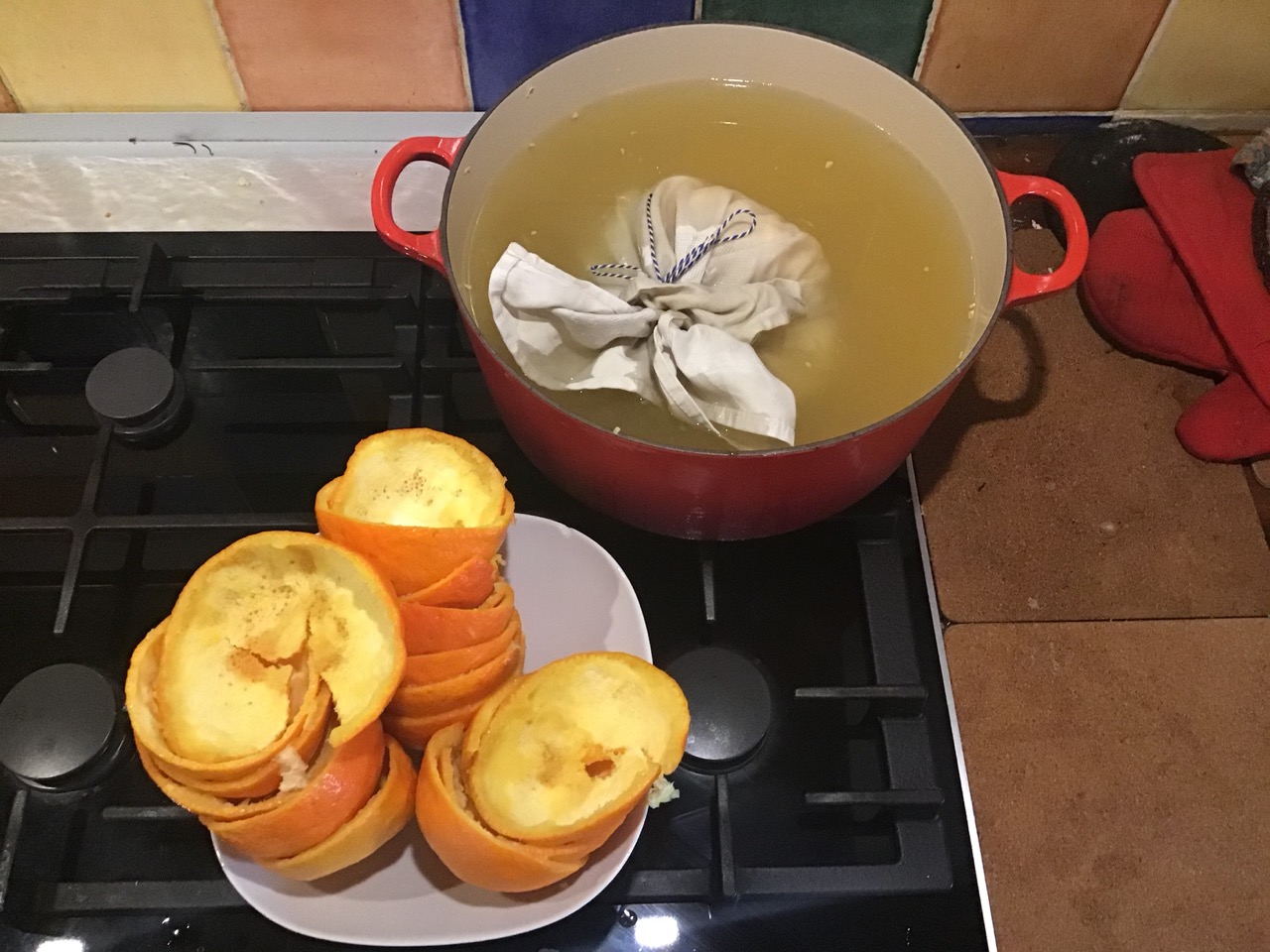
The oranges are sliced in two, juice extracted with a citrus juicer. Then the pips and pith are scraped out with a spoon. That is far easier than with regular oranges, actually. 

The remaining orange rind needs to be cut up in thin slices, or however chunky you want them to be. I started with one peel at a time, but that takes too much time. Just stack the peels and slice.

Now the cut rinds are cooked in the juice and 2 liters of water, about two hours. Hm, this calls for a pressure cooker.

The pips and pith are cooked along in a muslin cloth to extract (bitter) flavor and pectin. In the end you squeeze the cloth to extract all pectine etc. Well, that did not really work well. So I ended up cooking the pith and pips in a separate pan, and just sieving the result in a regular sieve to obtain the pectin. 

After the rinds are cooked and are soft you add the pectin you made, and the sugar. Dissolve, and boil a while. Put into sterilized jars with a jam funnel, to keep the edges of the jars clean. After about an hour hold the pots upside down to evenly distribute the peels.

All very well, but apparently I did not obtain enough pectin with this cloth method, the marmalade did not set and stayed sort of liquid. Squeezing the ball did not yield more pectin. Just sieving with a regular sieve neither. Ended up making an extra batch of pectin with 3 oranges and two lemons. Re-boiled the marmalade with that: still did not set well. Bought a packet of citrus pectin, reboiled again. That worked well.

Add the pectin powder to the cold jam mix, and stir in with a whisk, else you will immediately have pectin lumps, that will only dissolve by cooking really well.

Habets uses 4 liter of water to obtain 2 liters of marmalade, boiling it a long time and evaporating the water. That is a waste of energy. We can do with far less water. 2.5-3 liters max.   


Batch two: Pressure cooker

The second batch of marmalade was made using the pressure cooker. The whole idea of making marmalade is to first soften the rinds, obtain pectin, and only then add sugar and boil to make the marmalade set. So you can very well cook the peels separately in the pressure cooker, 10 minutes instead of two hours. (I did 40 mins at high pressure, as 2 hours :3 is about 40 mins. That is too long. 10-15 mins probably is right.) Pectin you can make with the pith and the pips in a small separate pan, in about half an hour. Just sieve with a regular sieve, cloth is not necessary. Put cooked liquid with rinds and pectin (+ bought pectin?) in a big pot, add the sugar, and boil. 

Put into sterilized jars with jam funnel to keep the rims clean. (Jam on the rims is a way for bacteria to enter the jar.)

Habets says to let cool the boiled mixture for 15 mins, else the peels will float to the top of the jar. It needs cooling far longer than 15 minutes, and I want the jam to be in the jars as hot as possible, so I hold the jars upside down about an hour later, to evenly distribute the peels.


Sunday, March 29, 2020

Bread again again: fish pan

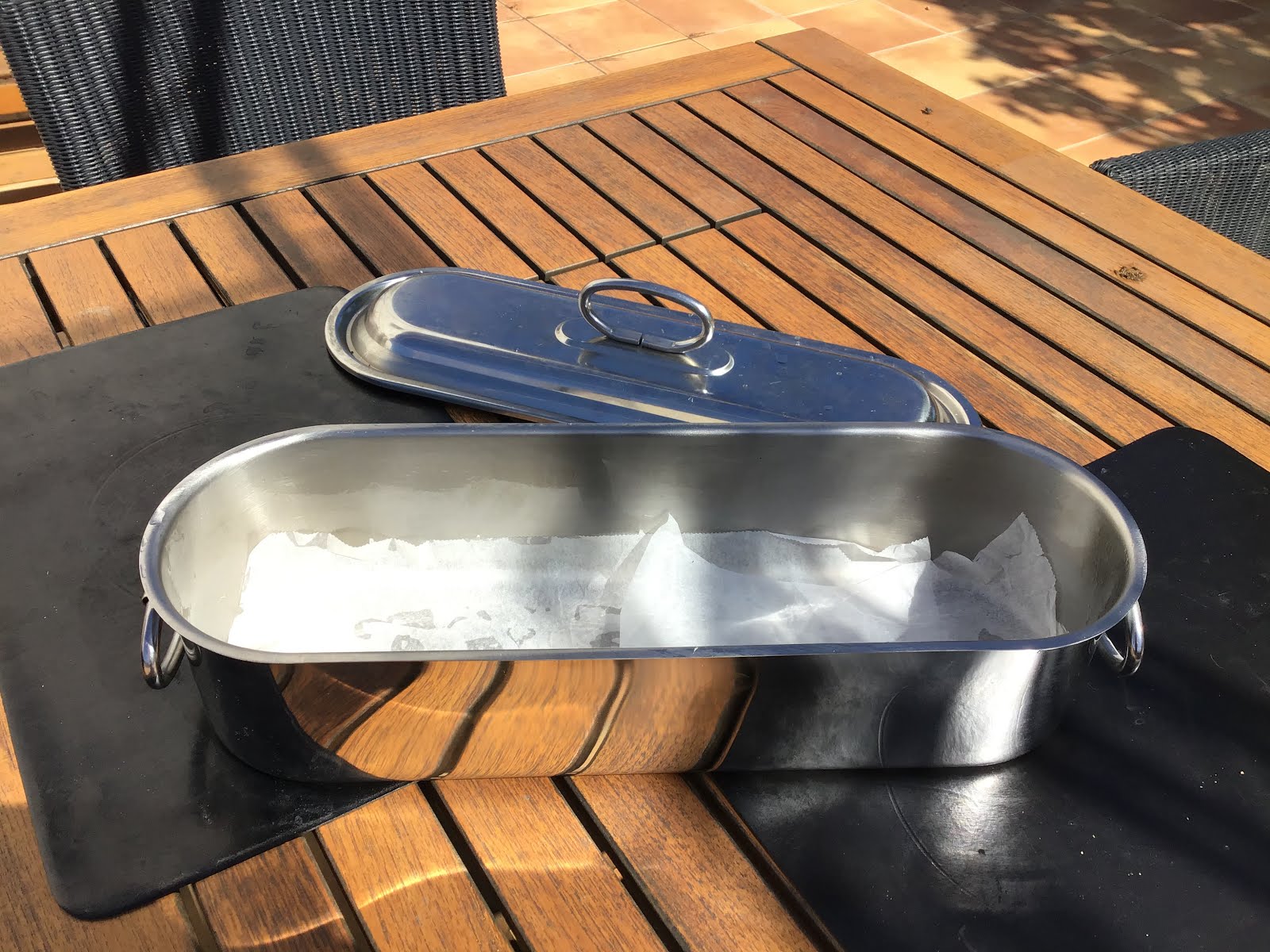
The "dutch oven" method for baking bread (use a hot cast iron pan, pre-heated 10 minutes in the oven @ 210º) is nice, but the round loaves are awkward. How about a once used fish pan?

Bread again: no no knead dough

Bread again. This time no-no knead dough. The no-knead method is nice, great crusts, but the inside of the bread is a bit.. pancake-ey. Not the fluffy crumb we like.

Here the dough is proved twice (45 minutes), and an after-prove of 70 minutes. It does work, and it even fills the pan. This is the best bread I've made so far.


Thursday, March 19, 2020

🍊🌳🍊🌳🍊🌳🍊🌳🍊🌳🍊🌳

6 Sevilla bitter 🍊🌳🍊🌳🍊🌳🍊🌳🍊🌳🍊🌳 for shade and marmalade
Naranjas amarga sevilla para sombra y mermelada.

Bought 2 bitter-orange trees (@ 15€), in the first place for marmalade, then noticed these are very tall trees. Why not plant these along the terrace and the pool for shade, as they do in Vera, and, Sevilla? So went back to Alonso Vera and bought 4 more, even taller ones, @ 20€.

They don't have tall branches, nor a decent root ball, despite their containers being big, but I'm assured these grow very vigorously. And we'll have a nice shaded area in no time.

These knobbly oranges are inedible, they are very bitter. But, these are the ones to make marmalade, and the true Canard à l'Orange, where regular oranges are far too sweet. We'll see. In Dutch these are called: "pomerans".


Hamstering

You are not allowed to shop with more than one, but we took the liberty to stock up at Mercadona each with our own shopping trolley, each doing half of the store.

Mercadona actually had nearly everything still in stock. Meat: completely stocked up. Only dishwasher tablets were nearly gone, all dried chick peas, and all crisps (chips), apart from one flavor.


Bought extra supplies to not have to visit for a while: 2 x 5 kg flour (bread!), 1 kg couscous, 4 kg rice, 1 kg spaghetti, 2 packets with 8 small tins of tuna, 16 big tins of dog food (4 flavors), 8 tins canned tomato, 1 bottle washing liquid, etc.

Spain in lockdown

Spain is in lockdown, which for us is not totally horrible, as we’re always sort of in lockdown ourselves, being more or less asocial to start with. Only allowed to go out to the shops for basic supplies. Took advantage yesterday to get a fresh supply of dog food. We are flexible, we can eat almost anything, but dogs are a bit less flexitarian, so I relieved Ramblizo of 4 big bags of Royal Canine. Regular for Zoomba and Papaya, Adult7+ for Coco, antiallergenic for Alma, and mini for Lucero. That should last us up to 2 months.

We still had 3 kg flour, if we cannot reach a baker, ca 5 kg of various dry pasta, 2 kg couscous, 1 kg migas, etc. And some pots of pesto, quite a few liters of olive oil, 5 kg sugar, 2 kg salt, 10 bottles of Guv’nor, 4 liters Campari, 1 bottle Grand Marnier, etc. We’ll survive. I hope.

No Kneading Crusty Bread

Yes baking bread, no kneading, perfect crust. And it works. Just mix flour, water, salt, sugar, dried yeast, the night before. In the morning dump the risen dough on a work surface, fold it a few times. Have a cast iron pan and lid ready in the oven at 200°, dump the dough in, lid on, 30 minutes. Lid off, a further 15 minutes. And: crusty bread!
Instructions: Yannick Lescure: https://youtu.be/kB19bv_tHI4 or: Jenny Can Cook: https://youtu.be/I0t8ZAhb8lQ

Basically: by volume (original recipe uses cups), 3 flour (500-800 grams), 1.5 quite hot water, teaspoon sugar, teaspoon salt, teaspoon dried yeast, mix up with a fork in bowl. Cover with plastic, towel, leave overnight. Cast iron pan and lid, preheat in oven at 200º. When 200º dump dough from bowl onto worktop, fold three times, put in pan. Lid on, in oven, 30 minutes. Lid off, 15 more minutes.