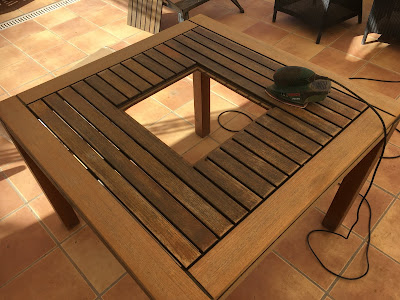
The table, sanding, oiling.


Added a shade sail extension along the garage, so there is more shade, and longer.


The reason the wire was loose is that the motor itself has turned inside the housing. It is “fixed” with a plastic ring with some notches that correspond to protrusions in the casing. If the mower gets stuck or whatever it gets a bump. Maybe it's sort of a safety feature? Better that the motor inside turns than the user gets hit.
I can imagine with the added aluminium it’s more prone to such impacts. Engineer Jansen has resorted to some screws and a blob of 2-component glue (probably made in China).

AUTOVACUNA: Covid jabs done! Almost two hours queueing in line with a few hundred cars. One appointment today, the other tomorrow morning, but they were flexible enough to jab us both. Eat that, Hugo de Jonge! (in 12 weeks time the other jab)

Know these grass cutters with a nylon wire? Endlessly the wire gets entangled in a big knot, so you need to load new wire onto the spool. Was about to throw this damn machine in the bin. Made in China, obviously.


In the background you can see the big irrigation water supply pipes. When in use, every few weeks in summer, a lot of water spills. Mangos love spilled irrigation water!

You haul 20 tons and what do you get...
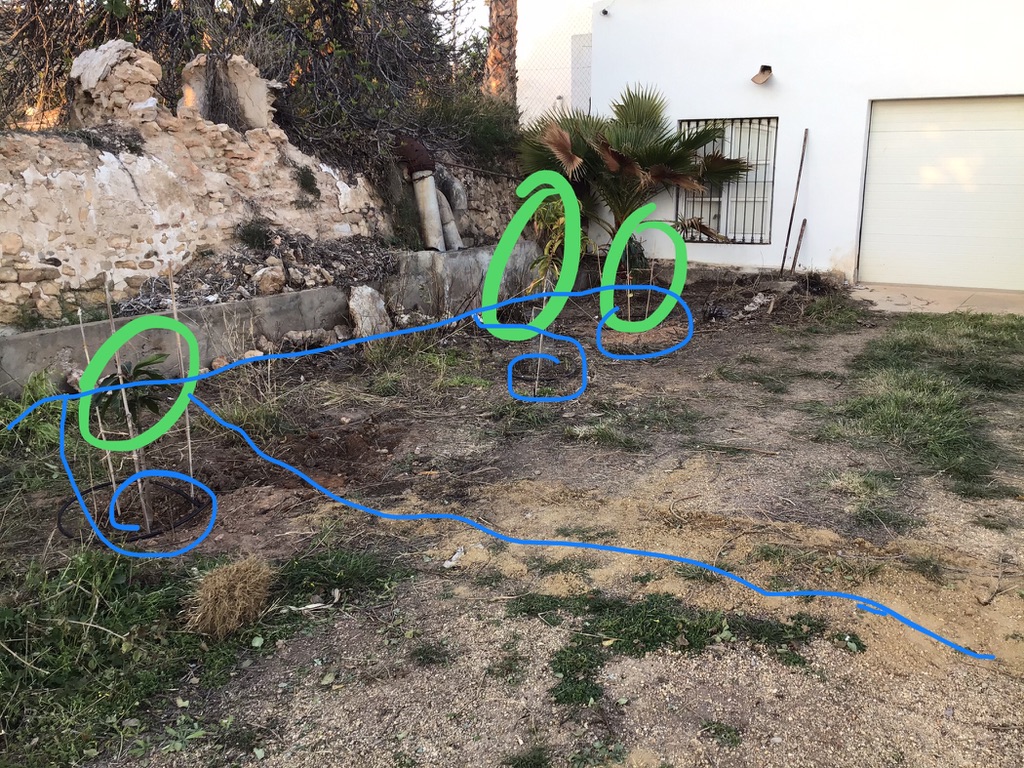
Plastic irrigation tubes don’t like sun, so into the ground they go.
It has been raining a few days, so the soil is nice and soft, so this is the chance to get this done...


40 creeping rosemary, 20 grey lavender, 20 green lavender, to plant around trees to keep weeds out, and the sun off the irrigation system tubes. Work work work.

The irrigation system. Each tree has a ring of 16mm irrigation tube with 3 pin pricks to let water drip out. Well, after a week it doesn’t. The holes are too small, and clog up. Or, plastic creeps, and the holes close again.

The good news is that a 4.5 mm hole in the 16 mm tubes fits this gap quite nicely. The wall of the tubes snap right between the taper and the nut, so the drippers sit tight. The 4.5 mm hole simply is made by hand and a 4.5 mm drill. Each tree gets 3, each bougainvillea 1.
Inside the dripper there is a small plastic cylinder that moves and sort of regulates the dripping. I hope this does not clog up...
Gardena has a whole collection of thingies in their Micro-Drip™ system. The orange drippers yield 2 liter per hour, the black ones 4 l/h. As I want the water to be spread a bit I give each tree 3 orange drippers. Ony the very big trees (Paulownia) get 4 l/h drippers.
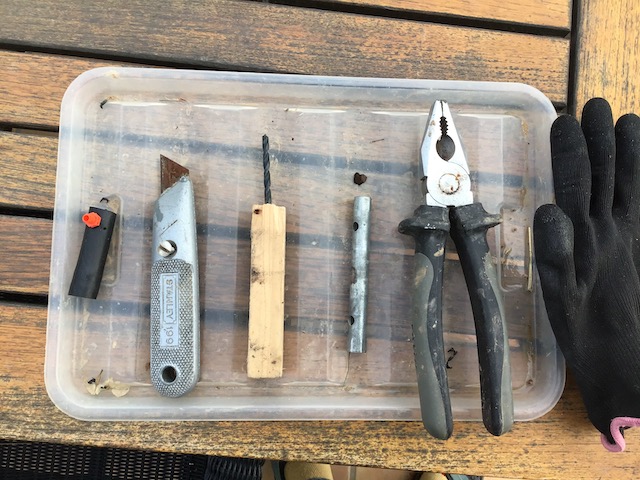
200 drippers (25 for €6,80, which is cheap, they're double in NL!). That is 200 holes punched with a tool I made from a block of wood and a drill, inserted by hand, give it a turn, then use the pipe wrench to screw it in, then push it past the wedge. Three days hard work. Pff. Now I only need to dig in the tubes in the ground, as plastic tubes and Andalucían sun are not a great match.
Have a look at all the various drippers, sprayers, etc etc, see below, or on https://www.gardena.com/uk/products/watering/micro-drip/

In Irrigatie irritatie // Irrigation irritation you can read how an irrigation network with thin-ish tubes was laid out, dug in, eaten by Papaya, and not that big a big success. Mainly because the pressure of the water is not that high, being gravity-fed from our balsa that is max. 2 meters higher than the ground level in the orchard. Each tree had a small tap, the blue ones in the picture, but even if you would open them very slightly the pressure dropped too much, and water yield per tree varied too much with the filling level of the balsa.
Watering by hand, and a small amount more, is a lot of work, takes a lot of time, and seems to be simply not sufficient, in summer. All in all the new growth in our orchard is a bit disappointing.
New plan! Make a ring around each tree, and make tine holes with a pin, so water just slowly drips, and pressure is not lost.

That is a roll of 100 m tube 16mm diameter, costing €17. Can I have two rolls please? Oh, make it three.

The circle around the tree is closed off with a stopper. Three pin-pricks to make holes for water to drip, and continously. No pumps, no valves or timers.
The bougainvilles all get one pinprick of water, the ones outside the fence with a little tube. The ones inside the gate directly from the tube.


Neighbours. Always neighbours. Even if you move to the Spanish countryside you have neighbours. This time it's about a measly strip of land that was retained 20 years ago by the family that sold the property, but probably did not register the changes too well. Now we want a fence, and there’s.. discussion.

People cross our land. On foot, on motorbike and by car, even though the passages that are not passages are blocked with stones, to make sure people don't take them for passages. Still they do think they are passages. We even had a moron moving the stones along the road and park his camper van there. Enough. Or "basta" as a certain royal said. This is now a garden, there are newly planted trees there, and watering hoses, etc. that we want to keep intact, thank you very much. So, a fence.


Hey, and don't we have a no-entry sign at the entry...?
Along with the work on the cellar a fence was installed, along the boundaries as the catastro shows us, but a bit inset onto our land as to not offend the neighbours, and leave access to the irrigation water taps and canals. Also, we left a wide opening to be closed with a chain, so it could be opened in case of trouble with the road, and people could pass by our land. Which is very nice of us.
Well, they were still putting up the poles when neighbour number one showed up, being warned by the irrigation water guy.
"Is there a problem?
"Si, problema muy gordo" (big problem)
We pointed at the catastro map, but that was indignantly shoved aside.
"No no no, catastro does not mean anything in Spain, here the land registry (registro) is the authority".
And, "These borders were agreed by the owners in the past, and defined by putting a big stone "mojón" on the border", pointing at (mind the possible date "18-1-63"):


Phone call from the actual owner, well, her son.
"So you are building a fence, I am going to denounce you and get a judicial procedure to sue you."
"Well, maybe we can talk about it, we can show you the catastro map, and what we have done."
He was there in five minutes.
"This is theft! It is like me going into your house and steal something!"
"Well sorry, sorry, we will solve this. If we are wrong about the border "linde" in Spanish we will move the fence. Another option would be to buy the land, if you are willing to sell?"
"Yes, for 15.000€ we will sell! *wraah*"
That is quite ridiculous for 610 m2 agricultural land, so we again said to him, "well the catastro show this..."
"No no no, catastro means nothing, the registro is the authority!"
"Well, we have the registro data for our property too, it's in our deed, I will fetch it, do you have your deed too?" (He said yes, but did not show it.)
Fetched our Escritura papers. Catastro: 5579 m2 Registro: 5540 m2. A deviation of 10% maximum is allowed, here it is less than 1%.
Side note: The property we are discussing is in between the road and our land, so there simply is not more land than is present on the ground. If the registro and catastro agree on the surface of our property that means the catastro measurements of that other plot must be correct, whatever the registro says about that other plot.
Here is that catastro ortofoto situation, blue lines around our land:

The owners's son said: I will call a technico, and he will explain to you the borders, and the catastro and the registro. Well, alright. He went away, and we continued work on the rain water drains.
Not less than 30 minutes later the local police showed up.
"What are all these works here then?!"
"What with all these stones?!" (that had been there two years already)
"Ah, are you here about that fence, that we just discussed with sr. <asshole's name>?"
He sort of nodded, and did not like that we noted that he was sent/called by this ...
"You need to declare all works at the town hall!"
"But, this is a private road and land"
"No matter, you need to tell the town hall every work on your house" (not true)
"Even if painting a wall?"
"Yes, hmm, painting maybe not, but you need to declare works at the town hall"
"But we did" (we did, using an official communication web form with citizen's digital certificate and all that they did not reply to)
"Yes, I already have an appointment the day after tomorrow" (I had)
"Hm"
"..." (silence, them slightly embarrassed)
"How are things with the [mad] neighbour?"
"All quiet, and he likes these rain water drains!"
They left, almost friendly again.
Next day the owner was back, with a sunglassed gring...guy in a suit.
"Are you from the Registro in Vera?", I asked
"No, I'm a technico, an architect."
I looked (very) disappointed and said "oh".
Side note: in normal countries the cadastre is an esteemed institute with authority, recording land ownership, borders, mortgages, etc. In Spain they have two bodies registering land. In Spain the "registro" is the actual authority on borders and area, the "catastro" is set up by the tax office, with main purpose the collection of taxes on land. Although today the registro and catastro are supposed to become more and more the same, there still are lots of discrepancies. If there is a difference of more than 10% in land surface they by law need to correct the registers.
The technico waved in front of us a sheet of paper with the image above, with an extra line drawn in at the green arrow. Then pointed at that, solemnly stating "REGISTRO". Then pointed at the blue line, stating "CATASTRO", and back to "REGISTRO", implying the bigger plot was theirs, and we would not understand if he used more words. How impressed we were.
I told him I was aware that the Registro registers the land and the Catastro is for the Hacienda, mainly set up for collecting taxes.
He nodded a big "YES".
"So, we seem to be paying the tax for their land?"
Shocked silence behind the sunglasses.
He then brusquely turned around and left, slamming his car door, obviously offended by this cheeky foreigner.
His story obviously was intended as bluff. There can be differences, but not as big as here. The land they used is more than 850 m2, and not the 610 m2 it is. (The A.H. owner is an A.H.)
We were left with the owner (the son) and discussed that we can move the fence to the actual border, if not correct. Or, another option would be to buy the land, so the location of the fence would be a non issue. He thought that a good idea too, and could we make an offer? We mentioned an amount that per m2 is a bit more than we paid for another bit of land. He would discuss this with his family and left.
Well, if the registro is the authority, we will request the Nota Simple for the land, and then we will discuss what to do.
The "Nota Simple" is an extract from the registro that you can request if you have the name and personal number ("NIE") of the owner. That information is always listed in the catastro data, and is public. And, you need a Nota Simple when you want to buy a property, or if you need to know the actual borders. Off to the registro.
"No, we have two land registries for this man, one of 9000 m2 and one of 6000 m2, but those are not this plot".
Odd. Well, if they cannot find the register for the name and NIE, then you need the land registry number "Numero finca registral". We asked the owner for this number four times.
"yes, this week I'm away, next week"
"I will get it to you on Monday"
"Yes yes"
(Nothing)
In the last message we received he sent a catastro(!) map. Could this be an implicit acknowledgement that he now also agrees the catastro is correct...?
I sent him (all this is by WhatsApp) a note that he sent not Registro data but a Catastro map, and if he could be so kind as to send us the finca number. Nothing.
Our town hall is also a "Punto Información Catastral". I went there to ask about the borders, and whether they knew the actual and official border, or even the finca number. No, but he could give me an up-to-date list of our neighbours, complete with land area, name and NIE. You get such a list in your deed when you buy a property, but of course things change. The owner of the property had not changed. Well, actually he died, but the catastro does not know that if you don't tell them.
The official did tell me that the owner of the plot had been there too, with the same request for information. That is strange, why would he...? Perhaps he is not the owner, or lost his papers..?
He clicked around in the catastro computer interface before my eyes, to show how the maps were in the past, and I noticed the boundaries were different, back then! That is interesting! Can you print them for me please, year by year? It was his pleasure. Below are the results.


In 2006 the house is still not part of plot no. 338 as it is today, although that must be an error, as the house was sold to the previous owners in 2005, and it must have been part of 338 then. Unknown what 003 and 9028 mean in the pink bit (house).


We were tired of waiting for the finca number, so we asked our lawyer to contact the owner's son and put on some pressure. Again his reply: "yes yes, next week".
But, again: nothing.
Went to talk with our lawyer. With 3 suggestions of followup letters.
1. "we assume that you, by sending the catastro map, acknowledge that the borders therein are correct. Please let us know within one week if you disagree, else we will finish the fence, and any costs in later changes are for you.”
2. “Citizens have the right to know the borders of their land, and you are obstructing that right. To solve this we could start a demarcation procedure (“deslinde”), and as you are obstructing our current efforts any costs involved are for you”
3. Yet another option: the registro can not find the land for the name and NIF that the catastro tells us. This may very well be an error or issue at the registro. Can we (strongly) ask the registro to put in effort to solve this? They are responsible for proper keeping of records, they cannot let a member of the public in doubt without helping them further.
Our lawyer did not like these options, and said, "well, if the registro and catastro agree on the size of your land, then you should just finish your fence and see what happens. Probably the land is not registered at all, to save costs."
Side note: If the registro and catastro agree on the area of a property that is very good (for us). The property we are discussing is in between the road and our land, so there simply is not more land than is present on the ground.
The lawyer said: "if there is a dispute the court will first order a land measurement procedure. My sister is a land meter! She has this GPS device, it costs about €800 for a property of 5500 m2 like yours."
"Hm." (this is a grmbl hm)
"Can we not measure his land? That's only 600 m2".
"No, you cannot measure other people's land".
"By the way: he said that if you make a door on his side, he will denounce you."
"Did he really say that?"
"Yes."
"What a nasty person."
Ah, what he means is the opening in the fence we intended to close with a chain, and open in case there is trouble with the road, so traffic can be diverted across our land. He thinks it is something we want to use, but it was not intended to be used by us, but for the neighbours in case of problems. We will now close the fence entirely, then. No problem for us.
Our lawyer thinks he is again bluffing, and all he wants is to make money out of a sale. Well, tough. We’re not interested in buying any more.
Engineer Jansen is not of yesterday, as the Dutch say, and he has Google Earth Pro on his computer: an application on the desktop that offers some more features than regular Google Maps via a web browser. One of its features is that you can draw lines and polygons, and thus measure distances and areas. That works very well, and is actually very precise. No need for a lawyer's sister and her GPS.
Here are the results. (click for full size)

(click to view full size) 5530 m2 (Catastro: 5579 m2 Registro: 5540 m2)