Environment

Environment

Friday, June 25, 2021

Tex (25 June 2021 +)


Did we mention Tex yet? Here he is, at a small park here in the neighbourhood, May 2021. Some people encountered him, petted him, called in some officials for a chip test, but did nothing. Suppose he had fleas, can't have that in your car! So they left him but put his pic on Facebook.
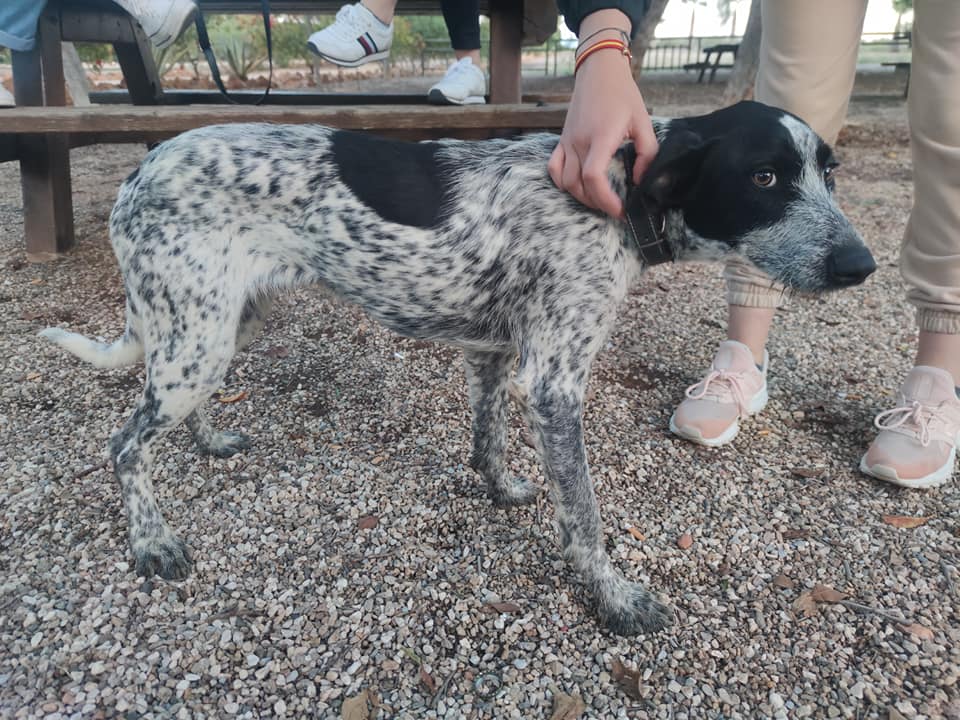


Then a few weeks later, there he is again, at a house not far from here:


Went over there, and indeed he was there, but was afraid of us and fled, so we could not catch him. Apparently he slept on one of the neighbours terraces, and they fed him once in a while, and provided water. We said that if they could catch him we'll collect him. And they did. 

Skinny!


They do seem to get along well, so far.

Best friends!
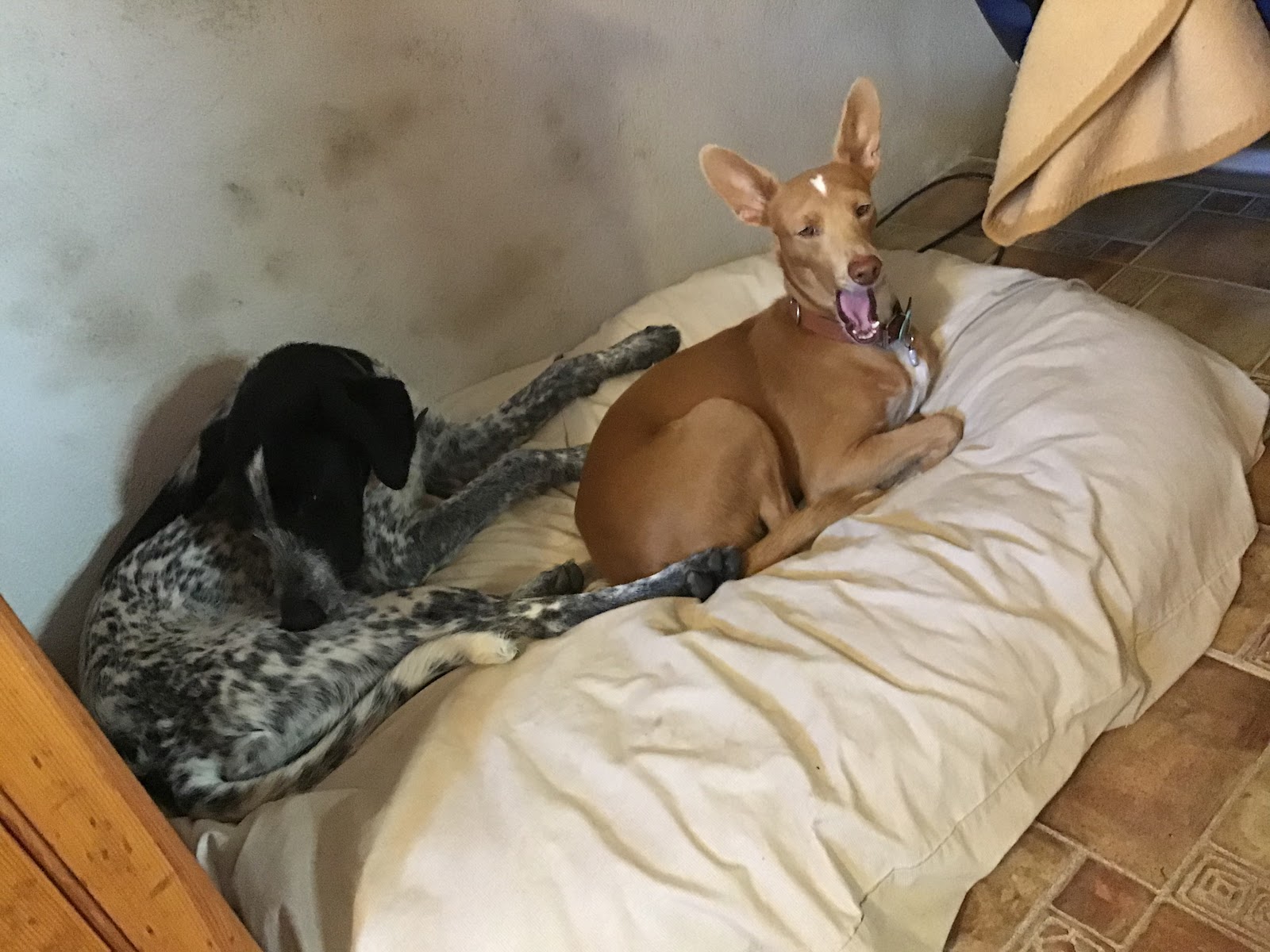


Until...! There was some excitement, and a fight between Lucero and Tex, early October 2021. Tex got bitten like this, while Lucero was bitten across his head, and had a puncture in a cheek, which was nastily swollen..


Lucero bettered quite quickly, with antibiotics and anti-inflammants, but Tex not so quickly. This wound is in a nasty spot, as the skin there moves with every step. But, by applying honey-salve, and bandaging in December 2021 the wound finally closed. Currently the skin has it's black pigment back, but still no hair.


What to do. 

First advise: "cut off their goolies"! Tex is now a year old, which means his testosterone levels are super-high, irritating Lucero, causing trouble irritating Tex, etc. 

We hesitated to do an actual castration right away, as some dogs change their character, or become frightened. Fortunately there is a temporary and reversible solution: a hormone implant called "Suprelorin".  That sits under the skin, and suppresses testosterone. There are 6 and 12 month versions. The vet had the 6 month available, so they both got that. Then wait 2 months for their balls to shrink (really), and testosterone levels to go down. 

Meanwhile we needed to keep them separate at all time, or they'd fight again. And dog fights are no fun. Scary too. So, either Tex was free in the garden, while Lucero and Papaya were inside the house, upstairs. Or, text would be locked up on the cave room downstairs, while Lucero was free.  We had to keep that regime up since October 2021. 

Currently (May 2022) we still cannot let them free together. They are reasonably ok together, but there still are moments of excitement where they will growl at each other. Mainly Lucero at Tex, actually. That means we still have to keep up a dog watch where either Lucero is free and Tex on a leash, outside, or both on a leash outside, or one of them inside the house. A bit like the river crossing puzzle with the cabbage, the goat and the wolf..

There are cute moments like this:

But, as soon as one gets a bit agitated there still probably is trouble.

So, in March 2022 they both lost their goolies, and we now have to see how things develop. Currently the separation regime is bearable. The alternative would be to rehome either Tex or Lucero. Tex would have the better chance of finding a new family, he's a really very good dog. But were quite fond of them both, so.. We hope the best of their castration, and will see how things develop.


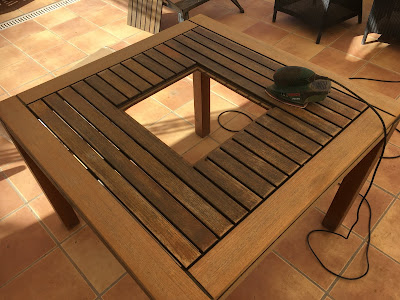


The table, sanding, oiling (25 June 2021)

 The table, sanding, oiling.


Saturday, May 29, 2021

Wednesday, May 19, 2021

Grasscutter, again. (19 May 2021)

 The reason the wire was loose is that the motor itself has turned inside the housing. It is “fixed” with a plastic ring with some notches that correspond to protrusions in the casing. If the mower gets stuck or whatever it gets a bump. Maybe it's sort of a safety feature? Better that the motor inside turns than the user gets hit.

I can imagine with the added aluminium it’s more prone to such impacts. Engineer Jansen has resorted to some screws and a blob of 2-component glue (probably made in China).


Tuesday, April 20, 2021

Vaczeuria, 1st dose (20 April 2021)

AUTOVACUNA: Covid jabs done! Almost two hours queueing in line with a few hundred cars. One appointment today, the other tomorrow morning, but they were flexible enough to jab us both. Eat that, Hugo de Jonge! (in 12 weeks time the other jab)


Monday, March 22, 2021

Grass cutter re-engineered (2021, March 22)

Know these grass cutters with a nylon wire? Endlessly the wire gets entangled in a big knot, so you need to load new wire onto the spool. Was about to throw this damn machine in the bin. Made in China, obviously.

Engineer Jansen thought about replacing the coil of nylon wire with a length of iron wire, but decided against that, for safety reasons.
Here is his other solution, that works *extremely* well, actually. (Obviously.) Just a length of cutter wire, and a knot. More than 30 minutes of undisturbed mowing has been achieved.


Mango (2021, March 22)

In the background you can see the big irrigation water supply pipes. When in use, every few weeks in summer, a lot of water spills. Mangos love spilled irrigation water!

And we love mangos that love spilled irrigation water!


Mango 3. And irrigation. (Mango 4 easily added...)

Wednesday, March 10, 2021

Irrigation... (2021, March 10)

You haul 20 tons and what do you get...

Plastic irrigation tubes don’t like sun, so into the ground they go.
It has been raining a few days, so the soil is nice and soft, so this is the chance to get this done...


Thursday, March 4, 2021

Creepy rosemary (March 4 2021)

40 creeping rosemary, 20 grey lavender, 20 green lavender, to plant around trees to keep weeds out, and the sun off the irrigation system tubes. Work work work.


Tuesday, March 2, 2021

Riego Continuado Continuado

The irrigation system. Each tree has a ring of 16mm irrigation tube with 3 pin pricks to let water drip out. Well, after a week it doesn’t. The holes are too small, and clog up. Or, plastic creeps, and the holes close again.

Engineer Jansen is now switching to Gardena Micro drip. Gardena wants you to use them as in the picture below, stuck into the end of their proprietary 4.6 mm irigation tubes. As you can see the drippers have a thread, followed by a tapered thing.

The good news is that a 4.5 mm hole in the 16 mm tubes fits this gap quite nicely. The wall of the tubes snap right between the taper and the nut, so the drippers sit tight. The 4.5 mm hole simply is made by hand and a 4.5 mm drill. Each tree gets 3, each bougainvillea 1.

Inside the dripper there is a small plastic cylinder that moves and sort of regulates the dripping. I hope this does not clog up...

Gardena has a whole collection of thingies in their Micro-Drip™ system. The orange drippers yield 2 liter per hour, the black ones 4 l/h. As I want the water to be spread a bit I give each tree 3 orange drippers. Ony the very big trees (Paulownia) get 4 l/h drippers. 

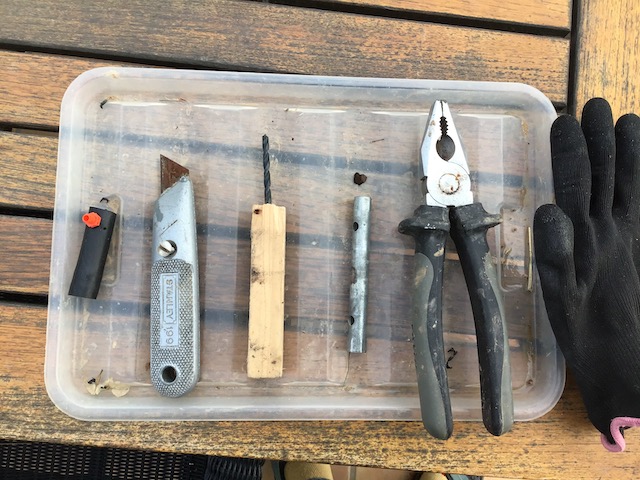
200 drippers (25 for €6,80, which is cheap, they're double in NL!). That is 200 holes punched with a tool I made from a block of wood and a drill, inserted by hand, give it a turn, then use the pipe wrench to screw it in, then push it past the wedge. Three days hard work. Pff. Now I only need to dig in the tubes in the ground, as plastic tubes and Andalucían sun are not a great match.

Have a look at all the various drippers, sprayers, etc etc, see below, or  on https://www.gardena.com/uk/products/watering/micro-drip/


Sunday, February 7, 2021

Riego Continuado

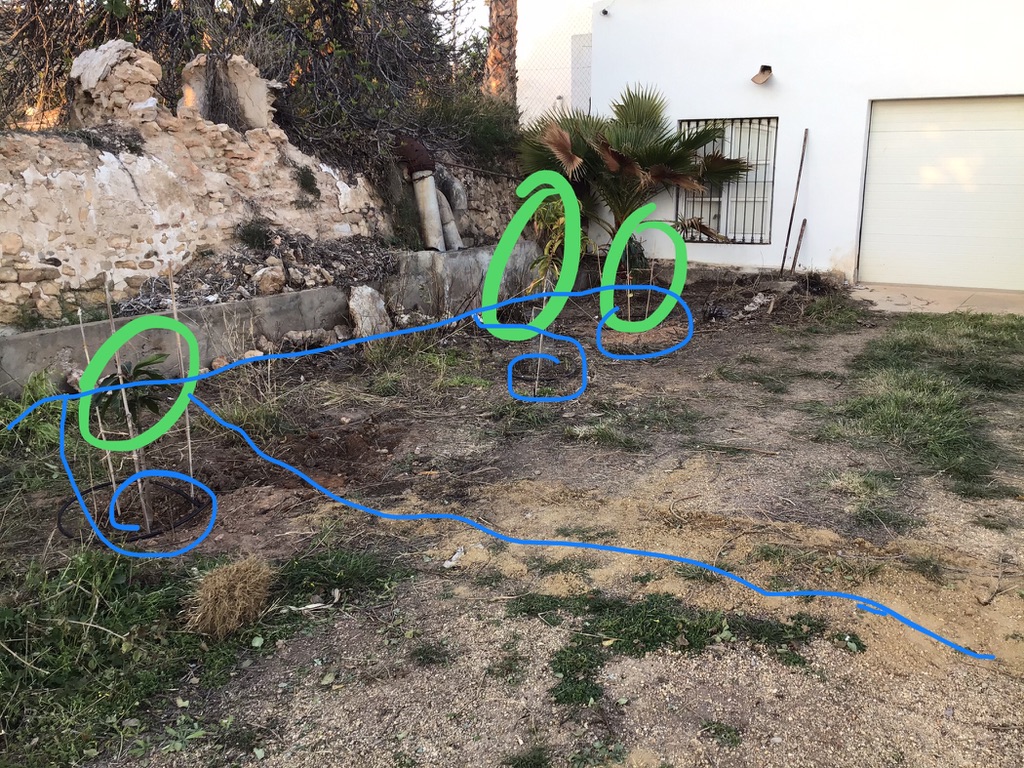
In Irrigatie irritatie // Irrigation irritation you can read how an irrigation network with thin-ish tubes was laid out, dug in, eaten by Papaya, and not that big a big success.  Mainly because the pressure of the water is not that high, being gravity-fed from our balsa that is max. 2 meters higher than the ground level in the orchard. Each tree had a small tap, the blue ones in the picture, but even if you would open them very slightly the pressure dropped too much, and water yield per tree varied too much with the filling level of the balsa.

Watering by hand, and a small amount more, is a lot of work, takes a lot of time, and seems to be simply not sufficient, in summer. All in all the new growth in our orchard is a bit disappointing.

New plan! Make a ring around each tree, and make tine holes with a pin, so water just slowly drips, and pressure is not lost.


16 mm tube, stoppers, T joins, taps, 25 mm to 16mm conversion thing.

That is a roll of 100 m tube 16mm diameter, costing €17. Can I have two rolls please? Oh, make it three. 


A circle around each tree of about 1 meter diameter takes 3 meters tube, we have about 50 trees, so you can calculate how much... I did not realise in the shop, so I had to go back.  I have now used up 5 rolls. 

The circle around the tree is closed off with a stopper.  Three pin-pricks to make holes for water to drip, and continously. No pumps, no valves or timers.

The bougainvilles all get one pinprick of water, the ones outside the fence with a little tube. The ones inside the gate directly from the tube.


So, inside the fence, and outside the fence all trees now have a circular tube, all happily dripping. So far it seems to work!

If more water is needed I'll append an extra bit of tube at each tree, with a small valve, so I can switch part of the capacity off, per tree, in winter. 

I may dig the tubes in. Or I might not.