Power to the people, or not, if your RCD breaks during the night. All switches are up, none auto-switched off, power to the top of the RCD, but none from it’s bottom. Engineer Jansen concluded the RCD needs replacing. He made it so.
Luckily the cellar has it’s own switchboard, and RCD, so we could power the fridge-freezer from there with an extension cord.
Cant’t even have a quiet nightly pee in this house!
We had quite a few short power interruptions the past few weeks, and naturally blamed Endesa for being useless, still. We’ll see what happens, and maybe we can be sorry for Endesa. (Update: 10 days on: no power interruptions) (Update: 20 days: still fine)
Environment
Showing posts with label endesa. Show all posts
Saturday, February 29, 2020
Tuesday, April 2, 2019
Postes electricas quitado
Finally. The ugly electricity posts that were attached to the house in the past, some 50 years ago, are finally gone. They were simply screwed onto the walls, breaking the side roof tiles in a bad way.
Also, the holes under the tiles at the side of the house are neatly filled with white mortar again. No more use for the plastic bottle in the middle picture to keep the birds out. (Second tile left off the post in the middle picture.)
Thursday, September 20, 2018
Lluvia - Rain - and the road
When it rains here it sometimes pours. And not just on us, b=ut on all our hinterland as well. Meaning that a lot of water is coming downhill. See below pictures for what happened.
And then you cannot leave by car, nor can your neighbours. Well, he was worse off, because he ran his car through the water in one of the river crossings, and his car stopped, and needed towing away.
Our neighbour Melchor, a kilometer away, has a roadbuilding company, and he built our road in the first place. He promised to drop by the next day, Monday. But didn't. Tuesday: "please don't forget us". Nada. The neighbour went to talk to the Ayuntamiento (town hall), as he thought that even if this is our road, and private terrain, the council is responsible for these repairs. They promised to drop by on Wednesday. But, didn't. The road still being not a road very much. In the afternoon suddenly our road building neighbour showed up. He had a death (a drowning?) in his family, and could not come earlier. Ok, this needs one truckloads of gravel and sand, and another with coarser gravel for the big holes. He could do that tomorrow morning. Meanwhile, the Ayuntamiento promised to come the next morning, and see what to do. We were a bit at a loss. Wait for the Ayuntamento, get it done on their budget, but not knowing when, or let Melchor do it, and pay. He estimated the cost at 300€ total. We decided to wait till the next morning. If no Ayuntamiento we'd ask him. When he had left 10 minutes, we thought "better let him do it, and be sure that it's done". So, Whatsapped him to ask him to do it, and that we had a lot more faith in him than in the council. Immediately: we'll be there tomorrow morning at 8:30.
Fifteen minutes later: a digging machine. Are you Ovimofit? No, Ayuntamiento. Hm. We had just asked Melchor to do it. We were sorry, and was this inconvenient for him? He called his boss. Who told him to make the road passable for the neighbour. But, that would mean just moving about some existing sand, while these holes needed filling with coarser material, as Melchor had proposed. So we told him: please no. More phone calls to the boss, but eventually he left.
Just a bit past 8 the next morning (Thursday) the digger and truck loads sand ad gravel arrived, and were put in place. He was so kind as to dig a shallow trench next to the road, to hopefully channel the water next time.
Rio Antas - La Cajete, as it is about once a year / every few years
The field behind us is walled, but overflows. Onto the new Endesa electric pylon, yes.
Upper part of our garden: inundated. Trying to divert the water out with some cleverly placed stones. Yes, that worked.
Hm. Yes, that is(was) our road. For us, and for the neighbours. The old pool was automatically filled.
Yes, that is the new in-ground Endesa cable. Did not expect to see that again so soon. Probably the earth there was still soft, and was washed away first. And no, Endesa did not come to help us. So much for allowing parties to do tyhings on your property, leaving you with the shit.
Canal along the road, to try and get the water to use that, next time.
And then you cannot leave by car, nor can your neighbours. Well, he was worse off, because he ran his car through the water in one of the river crossings, and his car stopped, and needed towing away.
Our neighbour Melchor, a kilometer away, has a roadbuilding company, and he built our road in the first place. He promised to drop by the next day, Monday. But didn't. Tuesday: "please don't forget us". Nada. The neighbour went to talk to the Ayuntamiento (town hall), as he thought that even if this is our road, and private terrain, the council is responsible for these repairs. They promised to drop by on Wednesday. But, didn't. The road still being not a road very much. In the afternoon suddenly our road building neighbour showed up. He had a death (a drowning?) in his family, and could not come earlier. Ok, this needs one truckloads of gravel and sand, and another with coarser gravel for the big holes. He could do that tomorrow morning. Meanwhile, the Ayuntamiento promised to come the next morning, and see what to do. We were a bit at a loss. Wait for the Ayuntamento, get it done on their budget, but not knowing when, or let Melchor do it, and pay. He estimated the cost at 300€ total. We decided to wait till the next morning. If no Ayuntamiento we'd ask him. When he had left 10 minutes, we thought "better let him do it, and be sure that it's done". So, Whatsapped him to ask him to do it, and that we had a lot more faith in him than in the council. Immediately: we'll be there tomorrow morning at 8:30.
Fifteen minutes later: a digging machine. Are you Ovimofit? No, Ayuntamiento. Hm. We had just asked Melchor to do it. We were sorry, and was this inconvenient for him? He called his boss. Who told him to make the road passable for the neighbour. But, that would mean just moving about some existing sand, while these holes needed filling with coarser material, as Melchor had proposed. So we told him: please no. More phone calls to the boss, but eventually he left.
Just a bit past 8 the next morning (Thursday) the digger and truck loads sand ad gravel arrived, and were put in place. He was so kind as to dig a shallow trench next to the road, to hopefully channel the water next time.
Rio Antas - La Cajete, as it is about once a year / every few years
The field behind us is walled, but overflows. Onto the new Endesa electric pylon, yes.
Upper part of our garden: inundated. Trying to divert the water out with some cleverly placed stones. Yes, that worked.
Hm. Yes, that is(was) our road. For us, and for the neighbours. The old pool was automatically filled.
Yes, that is the new in-ground Endesa cable. Did not expect to see that again so soon. Probably the earth there was still soft, and was washed away first. And no, Endesa did not come to help us. So much for allowing parties to do tyhings on your property, leaving you with the shit.
Canal along the road, to try and get the water to use that, next time.
Saturday, April 14, 2018
Digging Endesa
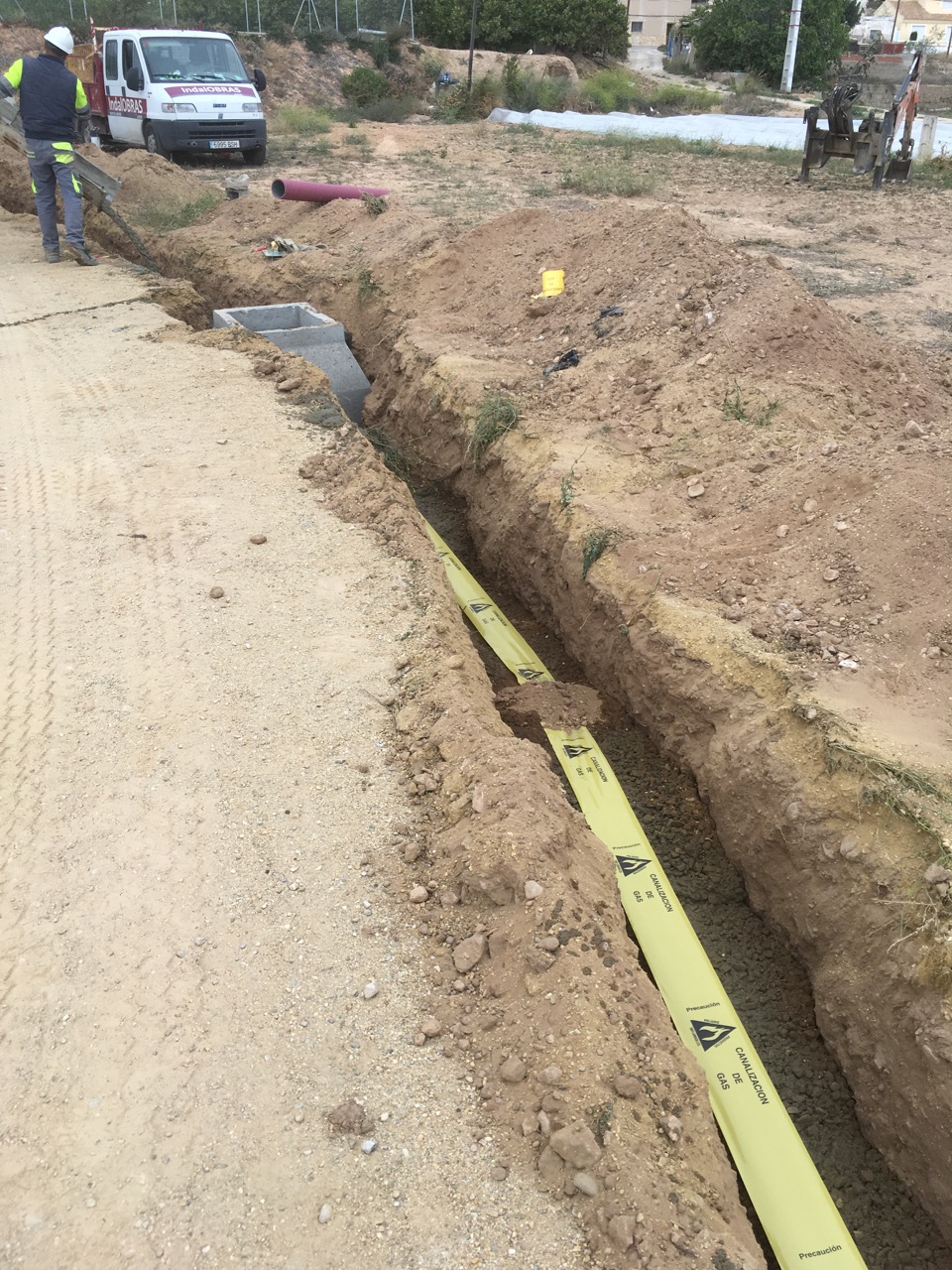
Endesa is the electricity company here. They have a transformer building behind our house, that they share with the other electra company Pastor. They don't like each other. The transformer will be replaced by a new one on a post at the beck of our land, while the old transformer building will be ours. Big advantage for us that the conduits that now run over our roof for supply of our neighbours will be removed. Our supply is now underground. The one for the neighbours will be underground as well. Two huge pipes for 8 houses.
And of course irrigation water pipes were damaged, and repaired.
Nice of them to dig a big planting hole for the paulownia for us.
old photo)
Paulownia hole
And of course irrigation water pipes were damaged, and repaired.
Nice of them to dig a big planting hole for the paulownia for us.
old photo)
Paulownia hole
Sunday, July 30, 2017
Solar panels, or not (hello, Enphase!?)
Now we have a swimming pool with a 1.2kW pump, running 8-9 hours a day, the decision to install solar panels has become more urgent. A big consumer like this costs 2€ a day, or about 800€ a year, while the sun is shining constantly. Alas, a private solar installation is not as easy a purchase as in The Netherlands. In the Netherlands you can feed back your surplus electricity to the grid, and you get paid for that too. In Spain the government decided to tax power generated by private solar panels. The lobby is strong, apparently. The idea is that you buy less electricity from the electricity companies, and thus you disadvantage other consumers. Of course it's just an obnoxious law, that "Europe" is protesting. But, the government here has been out of a majority for a very long time, and nothing much happened, and the law has not yet been changed.
What to do. We don't want to go "off the grid", and become totally independent. By day you use power form the panels and you charge the batteries. At night you use the stored power. But batteries are expensive, dangerous, end short lived (ten years). Remains "grid tied", where you use your own power first, and if your panels don't yield enough you use power from the grid.In the Netherlands that is all arranged, but here in Spain it isn't. There is another option: you do connect your solar panels system to the grid, but you don't feed back surplus power to the grid. That is called "zero grid feedback", or "self consumer". Zero feedback would be nice. No fuss with taxes, you are sort of independent, but you can still use power from the grid, if needed, like at night.
What/which system, and how big? Well, preferably more than 1.2kW for the swimming pool pump. But, do we keep on cooking with gas (bottles), or do we switch to electric? Atag refuses to market its products in Spain, see http://jansenendewaal.blogspot.com/2017/03/oven.html, so we could switch to electric cooking. A big electric "burner" is ca. 3kW, though that is not all day. And are we going for an electric car? As you can see we'd like to start small, ca. 1.5 - 2kW, and extend later.
But, the "inverters", the apparatuses that convert the direct current from the panels to 230V/50Hz alternating current are not that flexible. Most like a configuration within their capacity. Capacities range, for example, from 1700 W to 2140 W, while the next bigger version is 2500 to 3600 Watt. These inverters, that convert power from a series of solar panels, are called "string inverters".
There is another option: a mini-inverter, where each solar panel has it's own small inverter. Buy an extra panel, buy another mini-inverter. The manufacturer of these inverters is called Enphase: Enphase (https://enphase.com/). Good! Hm, no dealer in Spain. Yes in The Netherlands, France, Germany. Understandable, if Spain is making life for solar people difficult. But you can order your supplies by internet, and diy the installation, which is easy with Enphase.
Another advantage of micro-inverters is that they are long lived, about 25 years, versus 10 years for string inverters. And, a system built with separate inverters is very good with shaded panels. It will simply shut off panels that are shaded, and not the entire system.
Remains the choice for grid-tied, and yes or no zero-feedback. Before you know if this is possible with Enphase a lot of water has not run through the Rio Antas. Enphase themselves don't tell you much about zero feedback on their website. "Contact us" gives me no response (twice). My internet dealer says "I think it's possible". Ask on a forum, and one person says "yes it is possible", the other says "no you can't". Let's study this topic ourselves then.
Enphase has a number of series inverters that are basically compatible:
M215, 215W (4th generation)
M250, 250W (4th generation)
S280, 280W (5th generation)
IQ6 (60 cell panels, 230W) en IQ6+ (72 cell panels, 280W) (6th generation)
Modern solar panels yield 280-300W at the sunniest moment of the day.
Enphase does say something about zero-feedback: you need to apply a "zero feedback grid profile" using your Envoy. The Envoy is a small box that controls and monitors your collection of inverters, and delivers nice statistics and graphs via wifi. On Hawaii there are regions where you need to apply this zero feedback grid profile. But, you need a more recent series of inverter than is available in Europe: the S-series or the IQ. In Europe only the older M-series is available.
But, in Australia, where they have 230V/50Hz too, like us in Europe, there is the S270 (260 W)! But, that's Australia, and not here.
Strange people at Enphase.
And still no answer from Support.
After some more studying you encounter a comparable manufacturer: SolarEdge, who also have sort of a micro inverter, and a scalable system. It's the same company IKEA uses for their solar panels systems. But, SolarEdge is from a country I prefer not to do business with. Yes, Israël.
Studying further you see the financial situation of Enphase is not that great. Not strange if your support department does not answer and you don't market your products in Europe.. Anyway, 25 years lifespan and guarantee does require a company that is still around after 25 years.
Next year (2018) they will market the 7th generation "international inverter" that will make everybody happy.
But what am I to do now? I would be perfectly happy with the M250 inverters, but then I need to be able to install a system here in Spain that is allowed to feedback the grid. No answer about that from ENDESA, who are not overflowing with information either. Their support department is the same as Enphase's, apparently: still no answers.
Sigh.
What to do. We don't want to go "off the grid", and become totally independent. By day you use power form the panels and you charge the batteries. At night you use the stored power. But batteries are expensive, dangerous, end short lived (ten years). Remains "grid tied", where you use your own power first, and if your panels don't yield enough you use power from the grid.In the Netherlands that is all arranged, but here in Spain it isn't. There is another option: you do connect your solar panels system to the grid, but you don't feed back surplus power to the grid. That is called "zero grid feedback", or "self consumer". Zero feedback would be nice. No fuss with taxes, you are sort of independent, but you can still use power from the grid, if needed, like at night.
What/which system, and how big? Well, preferably more than 1.2kW for the swimming pool pump. But, do we keep on cooking with gas (bottles), or do we switch to electric? Atag refuses to market its products in Spain, see http://jansenendewaal.blogspot.com/2017/03/oven.html, so we could switch to electric cooking. A big electric "burner" is ca. 3kW, though that is not all day. And are we going for an electric car? As you can see we'd like to start small, ca. 1.5 - 2kW, and extend later.
But, the "inverters", the apparatuses that convert the direct current from the panels to 230V/50Hz alternating current are not that flexible. Most like a configuration within their capacity. Capacities range, for example, from 1700 W to 2140 W, while the next bigger version is 2500 to 3600 Watt. These inverters, that convert power from a series of solar panels, are called "string inverters".
There is another option: a mini-inverter, where each solar panel has it's own small inverter. Buy an extra panel, buy another mini-inverter. The manufacturer of these inverters is called Enphase: Enphase (https://enphase.com/). Good! Hm, no dealer in Spain. Yes in The Netherlands, France, Germany. Understandable, if Spain is making life for solar people difficult. But you can order your supplies by internet, and diy the installation, which is easy with Enphase.
Another advantage of micro-inverters is that they are long lived, about 25 years, versus 10 years for string inverters. And, a system built with separate inverters is very good with shaded panels. It will simply shut off panels that are shaded, and not the entire system.
Remains the choice for grid-tied, and yes or no zero-feedback. Before you know if this is possible with Enphase a lot of water has not run through the Rio Antas. Enphase themselves don't tell you much about zero feedback on their website. "Contact us" gives me no response (twice). My internet dealer says "I think it's possible". Ask on a forum, and one person says "yes it is possible", the other says "no you can't". Let's study this topic ourselves then.
Enphase has a number of series inverters that are basically compatible:
M215, 215W (4th generation)
M250, 250W (4th generation)
S280, 280W (5th generation)
IQ6 (60 cell panels, 230W) en IQ6+ (72 cell panels, 280W) (6th generation)
Modern solar panels yield 280-300W at the sunniest moment of the day.
Enphase does say something about zero-feedback: you need to apply a "zero feedback grid profile" using your Envoy. The Envoy is a small box that controls and monitors your collection of inverters, and delivers nice statistics and graphs via wifi. On Hawaii there are regions where you need to apply this zero feedback grid profile. But, you need a more recent series of inverter than is available in Europe: the S-series or the IQ. In Europe only the older M-series is available.
But, in Australia, where they have 230V/50Hz too, like us in Europe, there is the S270 (260 W)! But, that's Australia, and not here.
Strange people at Enphase.
And still no answer from Support.
Ticket : 00982541
Submitted : 6/24/2017
Subject : Solar panels system with Zero feedback to grid - Envoy-S standard or metered?
After some more studying you encounter a comparable manufacturer: SolarEdge, who also have sort of a micro inverter, and a scalable system. It's the same company IKEA uses for their solar panels systems. But, SolarEdge is from a country I prefer not to do business with. Yes, Israël.
Studying further you see the financial situation of Enphase is not that great. Not strange if your support department does not answer and you don't market your products in Europe.. Anyway, 25 years lifespan and guarantee does require a company that is still around after 25 years.
Next year (2018) they will market the 7th generation "international inverter" that will make everybody happy.
But what am I to do now? I would be perfectly happy with the M250 inverters, but then I need to be able to install a system here in Spain that is allowed to feedback the grid. No answer about that from ENDESA, who are not overflowing with information either. Their support department is the same as Enphase's, apparently: still no answers.
Sigh.
Subscribe to:
Posts (Atom)