Environment

Environment

Monday, March 7, 2016

Coup de coeur #6: Moulin de Roche

(A series of "Pierre, what do they not have" posts)

Moulin de Roche. I found this one just after returning home from Moulin de Chateaurenaud. It had been way above budget, but a new deal was offered now, where only 1 hectare of land was sold, instead of 4.5 ha. And that was at the top end of our budget too, but do-able if the price would be negotiable, and not too much work was to be done to do up the house.

The usual questions (state of the septic, parcelles cadastrale, etc) would need answers before visiting the Charente again. Had we seen the advertisements before we could have visited... Here the problem was that the house was advertised by at least 5 different estate agents. One was able to tell me the parcelles cadastrale, but then remained silent. The second divulged that the septic was not "to norm" and needed replacement. When I asked him if anything was investigated about that replacement he remained silent too. The third never replied, even though at no more than 1 km from the house. The 4th was able to tell me the house has an air-jet heating system, but then remained silent, too.

I let it rest a few weeks, but it was still nagging. This is such a nice place! I wrote an email to the mairie to see if they perhaps could let the owner know I was interested. Nothing. I can imagine they thought it very odd that a foreign person writes such emails to them, but hey. A week later estate agent 4 sent an email if I was still interested, because another party had shown interest! Well, who could that be? I thought it must be myself, and that perhaps the mairie indeed had contacted the owner.

Then I found estate agent #6, and I think they were the actual and main estate agent for this house. She wrote me that she knew the house very well, from childhood even, but that it had just been sold. The story of my house buying life.

I will never sit here.

Or here.

Or there.

Apparently this mill had lost it's water rights. The wheel was gone too, and replaced by a bathroom. What a waste! It is possible to get water rights back, but that is a long bureaucratic process. You cannot buy a mill and simply hope you will get those rights back. What would have been very possible here is to install a heat pump to heat the house, instead of that oil-fueled jet system. A river flowing under your house has a big heat reservoir!

I would have loved to be the custodian of this historic building for a number of years. But, it was not to be.

Coup de coeur #5: Moulin de Braqueville

(A series of "Pierre, what do they not have" posts)

Well, you cannot deny me a taste for quaint properties. Here is a very special one. It's the Moulin de Braqueville, located on the river "Dure", near Montolieu.

The house is located high above the river, which explains it is still there. Quite contrary to the actual mill building, the remnants you can see below. A disaster happened here, September 8th 1871. Enormous rainfall in the Montagne Noire caused a massive surge of water, causing destruction in the whole area, including the works of the Moulin de Braqueville. It was never rebuilt, and the mill is as you can see it today.

This house was advertised on IADFrance, and only there, as far as I could see.


Here is a case of a totally unwilling estate agent:

Bonjour,

Ce moulin ne correspond pas à vos projets.

Bien cordialement,

Catherine TAILLEFER

and

Bonsoir ,

Comme je vous l'ai dis dans le message je ne pense pas que ce bien corresponde à vos projet, par contre si vous voulez le voir je fais une visite vendredi à 15h30, si vous voulez en profiter c'est avec plaisir.

Bien cordialement,

Catherine TAILLEFER

How kind. And just a few days notice.

But, more roads lead to Rome. There are very nice panorama pictures online of this house. I wrote the maker that I really liked the place and his pictures, and perhaps he knew the owner? He did! The owner was an old friend of his, who sadly died the year before. But he would let the daughter know I was interested. A few days later I got a very kind email thanking me for bringing interest to the house, but that sadly for me it was now sold, that very day.

I like to think I helped the sale by expressing interest, and pushing the other interested party. I still hate this estate agent. The house was nice, and within budget, so..

I would not have minded to live with this view, after throwing the pot down the river.


Ok, this interior is a bit old, and the estate agent's papers are included in the photo. (Often the case! They make a picture of the kitchen, but with the briefcase and all paper on the table.)

Sunday, March 6, 2016

Coup De Coeur #4: Moulin de Chateaurenaud

(A series of "Pierre, what do they not have" posts)

Now and then you can buy enormous properties in France for relatively little money. Sometimes because the place really is a dump, but sometimes because a property is inherited by children who don't like the place, and it only costs them to keep a house from totally falling down. Sometimes because of a lot of reasons. Here is a place that qualifies for many of those reasons.

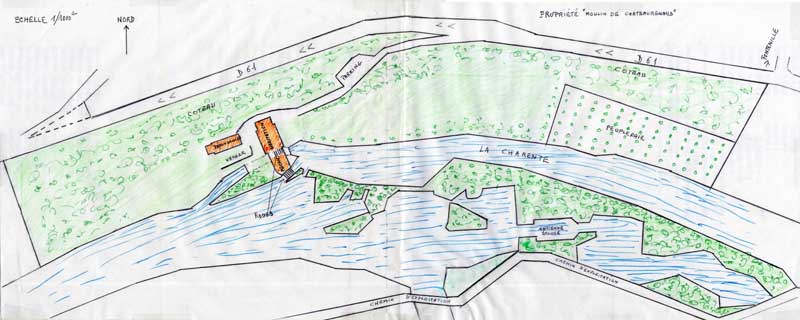
It is a (very) old mill in the Charente area, near Mansle: le Moulin de Chateaurenaud. Already mentioned in the Middle Ages, but rebuilt a few times. The current set of buildings was probably erected in the middle of the 1800's. It was at least partly a wood sawing mill. At the beginning of the 20th century it was converted to generate electric power, with a giant waterwheel. I guess it stopped working before World War II, and was more or less abandoned since. The family kept up the place as far as they could, apparently replacing the roof in the 1980's in an attempt to at least conserve the building as it is.

It had sustained a lot of damage already, with the old roof leaking like a sieve with a hole in it, which made wood rot, and some ceilings collapse. They just replaced the roof, but did not restore the interior. So that was untouched since ca. 1940-ish. Untouched by man. Not so much untouched by nature's hand. Wood worm, mould, fungi, damp, rot, all had their "hands" on the place.

But, you don't have to restore everything you can, and if you have the time, the means, the skills, the willingness, the determination... you can do a lot. Chateaurenaud certainly has that certain je ne sais quoi, at least for me. Here at home it was mostly frowned upon though.

There are two parts in a property like this: 1. a place to live 2. a place to do a bit of production. The production part was promising (to me). The big waterwheel was still there, with all the machinery intact. Even the old electric generator was still there. The wood of the waterwheel was all gone, however. But, that can be restored without too much difficulty. It's just planks of wood. Or aluminium, as I would have done. A new generator, et voilá! d' electricité!

A bit more complex was the living part. This house has no modern amenities. No water. No electricity. No sanitation. No telephone. No heating. And, no proper floors, any more.

I was aware of these pictures before visiting, but could not quite determine the state of things. Nor could a surveyor I contacted to look at the photos too. He did suggest the following: these are floors that are simply constructed by laying wooden beams onto the bare soil, and put the planks on top of that. He was quite right. And you know what? Floors constructed like that don't last 150 years. They get damp, they get woodworm, mold, and in general, they get eaten.

I had asked the owners what had happened to the floors. He rep-lied that probably something too heavy was put on the floor, and that that had made the floor collapse. However, my surveyor was right. I stuck my finger through a hole in the floor: damp soil.

There is a big kitchen there. And that is the only positive qualification. It was quite obvious this house has a water problem, the nice and big stones on the floor are wet at the edges. If you jump up and down on one you can see that water wells in between...

This is the so called "champignon de plâtre". It grows on old plaster, where the humidity is above 80%. This house has nice plaster ceilings in most of the house. Plaster ceilings are constructed by first attaching thin wooden slats to the beams of the ceiling, and then just slapping on plaster to get a nice and even white surface. But, this leaves a space between the plaster and the wooden floor on top of the beams. That space gets occupied by fungi, mold, mice and anything that does not like the light of day.

A bit like this, yes.

And this.

Did I mention there's a room where there was only a small chimney fire?

What to do about this place? Well, it can be restored. The roof is not bad, the stone walls are fine, but all woodwork is beyond repair. The house needs to be stripped, completely, including windows, doors and shutters. No idea if the floor beams for the upper floor and attic are still ok, but the floor planks themselves aren't.

The floors of the ground floor need to be removed and burned, and the soil underneath them excavated so a space is created that can be ventilated, so the floor stays dry. You can then construct a floor with "poutrelles" and "hourdis", and finish that with underfloor heating and a layer of concrete. Poutrelles are smallish concrete beams that you can carry with two people, and put in place. Then you fill the space in between two such beams with "hourdis", lightweight panels. Sometimes polystyrene, sometimes lightweight concrete, or even terracotta. Then you put an iron reinforcement mesh on top, call for a tanker car loaded with concrete, and a layer of liquid concrete is poured on top of your modular floor. And it's done. (More or less.) It is something you can do yourself. A very useful site is http://www.klussen-in-frankrijk.eu/ by Christian von Klösterlein, also known as "le bricoleur" on a certain forum for Dutch people in France. A forum that is inhabited by some very nice and helpful people, but also some completely irritating ones. Like a talking vegetable stew.

And, the house needs drains around the building. It is located next to the Charente river, so at the bottom of the valley. All water flows down, and towards the river. Also underground. The whole property is wet, squishy, swampy. The house does not have gutters. That means that water splashes down from the roof onto the ground, and back up the walls. So, the walls are wet too. See the picture on the left, the plaster has fallen down.

Drainage is a risk for the building too. I think it was not constructed on solid rock, but more or less on a bank of clay and sand and stones. What they do is dig a trench, put big stones, or big wooden beams, on the bottom, and construct walls on top of that. If you start to take the water out, the soil will dry, and shrink. Consequently, the walls may crack.

It will take a few years of hard work, quite a lot of money, but most of all determination, and love for this place. And a partner that shares those feelings and determination. And the willingness to camp there in a caravan at least half a year without running water, electricity etc. I did mention the family was frowning on this place? That did not become any better. Au contraire.

Add that the asking price for this property was such that not enough was left for the restoration. The owners would have had to at least halve their asking price before I could have confidence in the finances. We did not even try that. (i.e. I was not allowed..)

Getting electricity and water connected would have cost a lot, although you can generate your own here, and there's plenty water.. Generating electricity is very possible here. The water rights for the mill are still there!

Oh, I haven't mentioned sanitation yet. Of course there's no mains sewer here. There's no septic tank either. Millers just peed in the Charente. (There is a dry toilet in another building.) Near rivers septic tanks are no longer allowed, nor is it allowed to have the septic overflow field near the river. That means you must construct/buy a "microstation d'epuration", a sort of above-ground septic tank that is mechanically stirred, and breaks down waste quite quickly. For a house this size (12 rooms) you need a big one. Expensive.

Someone has bought it though. And with the purpose to generate hydro power, apparently. See their site: http://www.moulindechateaurenaud.com I will follow closely, and a bit jealously, though not enviously, what happens there the years to come. I might even give them the old postcard I bought, with the waterwheel before the current wheel.


PS
There was an amusing misunderstanding where someone mentioned that he bought pineau by the jerrycan, and someone else replied that she absolutely loves pinot.

Thursday, March 3, 2016

Coup De Coeur #3: Moulin en Sauve

(A series of "what do they not have" posts)


This is Sauve, a medieval small town in the Gard region, located on the river called Vidourle.

This mill is beautifully located at the edge of Sauve. The Vidourle can be seen at the back of the picture, flowing under the bridge. That bridge is at the very right side in the top picture.

Very special is that in the middle of Sauve there is the "Fontaine de Sauve", where an underground river re-surfaces. That water flows along this mill-house into the Vidourle. This river is fed by rainfall in the Vaucluse, so there can be water aplenty.

There can be more water than you like, as this picture shows. This is the water from the Fontaine de Sauve, not the Vidourle.

This water, however, *is* the Vidourle. And yes, that is the garden of the house. And no, I don't have a photo of the house actually flooded.

The Vidourle apparently is a very dangerous river. It is fed by rainfall, which can be quite impressive in this region. All that water is then forced into narrow valleys, causing what is called "vidourles": sudden vicious floods.

The garden and cellar of this house probably get flooded quite regularly. That includes the garage. The living space is on the first and second floors (second and third floor for you English types), so probably stay dry. Mostly.

This is a picture postcard house, isn't it?

This was the first encounter with a "ghost" for-sale website: a site that advertises houses that are long sold. MaisonAVendreUK? Not answering e-mails, and pretending to take action when you call them on the phone. Rubbish. And odd. Oh, you get blocked on twitter if you let them know you wasted time on them. Usually English estate people are pretty good.

This is a house that we liked even if it does not have all requirements, like a big block of land, peace and quiet, etc. It just has 800m2, but it looks so nice, and as a mill it seems to get plenty of water. I would have liked to install a turbine under the house. And living in a quaint town has it's merits too. Sauve has looks, atmosphere, restaurants. We were worried that the privacy here would not be great: you have a nice view on the house from the big bridge, and also from the upper part of the city. And there's a children's playground on the other side of the water.

I don't know if it is because of the floods, but this house is for sale again. And at a price more than €100.000 above the price it had in 2012.

Coup De Coeur #2: Le Cabanial

(A series of "what do they not have" posts)

Second house, not far from the Moulin du Roy, and to be visited during the same week as the aforementioned house is a "bergerie" in the Montagne Noire in Aude, near Cabrespine. A bergerie is a hut with a stable where they keep sheep. These days there are more sheeple than sheep, so many bergeries are now transformed into houses. As is this one.

It's a vacation rental, but why not live there permanently? Well, one reason could be that there is no electricity connected. There is a big array of solar panels that provide power. How that is done at night I don't know. But I was to find out. It is a nice and big block of land, with a river flowing around it. And, lots of trees. The house itself looks nice, although it will need some work to get some extra floorspace. Perhaps some glass around the back terrace?

The town drinking water is extracted from the river at the very end of this property, so there's enough water here!

Alas, a few days after the message that the Moulin du Roy was sold, this house was sold, too. We canceled our trip, and Ryan Air was €140 richer without even having to offer me coffee.

You can holiday rent the house: http://lecabanial.com


Coup De Coeur #1: Moulin du Roy

(A series of "what do they not have" posts)

What we wanted: a nice stone house, "pierres apparentes", preferably in the middle of a few hectares of woodland to A) keep neighbours at a distance and B) have eco-friendly firewood to heat the house in winter. Where in France did not matter really, we like all regions, though the more south the better.

This house caught our eye quickly, end of August 2012. It had been for sale quite a while, but it was a bit above our budget. Then a price drop came, and we decided to send an email to the estate agent. This was my first mail exchange in French, but it was taken surprisingly well. And, he disclosed that the price was even "negociable un peu". Even better, he was willing to tell me the location. This is a house that you cannot find with Google Maps or Earth, it is completely hidden in between trees. Lovely!

There were some doubts too. A small sewage processing facility can be clearly seen on Street View, and this is less than 50 meters from the house. Is that a pumping station, too, in that little building...? (yes). The kitchen looked a bit tired. As did some other rooms. Well, this is a house that was restored in the 80's, so some upgrading was probably necessary. Remember this is the first house we spotted long-distance, today we would not fuss about such details. Further doubts: this house is located in a valley, on the north side of a hill. That means it's nice and cool when it's hot, and nice and cold in winter. Not much sun anyway, while we planned solar panels for electricity. But, the plan cadastrale revealed there's a bit of land near the top of the hill, on the other side of a small road.

The small waterfall apparently was not part of the property itself. That did not feel good. It's owned by the community, so at least not by a neighbour. But, being quite neighbour-sensitive it was a worry for us. Anyway, end of September 2012 we decided to go and visit, October 13th. No, a Saturday. Booked a Ryan Air flight (140€ all-in).

When I confirmed the flight to the estate agent I got back an apologetic mail: the house was sold that afternoon, for the asking price.

That was a huge disappointment. I had quite fallen in like with the place. The waterfall, the quirky layout, the trees... And I had scanned the environment with Street View quite well. Even though the house is secluded it would have been easy to get to shops on a bike. Sigh.

They would go and sign with the notary that afternoon, but if anything happened and the sale would halt they'd let me know. The buying process of a house can halt for various reasons. There's a cooling-off period, there's a period where you can arrange finances, mortgage, etc. Or, they may buy a house on condition of obtaining building-permits.

When listlessly googling the house a bit more I stumbled upon a vacation house rental site. And, there was my house! Advertised by English owners, complete with e-mail address. Damn, could have contacted them, and discussed the place in English, and probably could have bought the house at the asking price minus the estate agent's fee! (Up to 8% in France!) The extra pictures of the interior, and the photo's of children bathing in the sun only added insult to injury.

I wrote them an a-mail anyway, telling them I was sorry not to have found them earlier, etc. Got mail back that they were sorry for me, but that they would let me know if the sale did not go as planned.

Then, early November I got mail from the (old) owners if I was still interested? Apparently there was a clause in the contract that they had overlooked, where the new owners would only buy if they obtained planning permission, and that this still was not granted, so they still did not know if the sale would actually happen.

It finally did, early January 2013.

I was very sad. And that for a house I had nearly visited. I still dream of this place, at times.

I later learned that my contacting the owners has made it a bit difficult for the estate agent, as they had to wait more than 3 months before finalizing the sale, while another party was more than interested...


And now, 3 years later? I'm not sure. It still looks like an immensely romantic and lovely property, when the sun is shining. But, in winter it can be dark, humid, cold, miserable and depressing. And that little building indeed is a pumping station. If there's anything that I find annoying it is a machine droning nearby. If it'd be for sale again it would certainly be like an electric shock, but it would probably be out of reach. It was at the upper end of our budget then, and the new owners are putting in work. So, Their buying price + taxes + work means it is out of reach for us.


Tuesday, March 1, 2016

Zoomba and the poor pink paw


We did not see it happen, but it did. This little energetic, acrobatic creature managed to break a toe. On flat grassland. Wooshed after a ball, and right when you don't watch and mind your own business your dog comes limping back, holding up her paw. She does this too when a nasty little thorny seed attaches itself to her paw, so we can unpick it. Here there was nothing to unpick, this time.

We carried her home, all 18 kilos. She was still wooshing around, chasing the cat in the garden, jumping up and down the couch, and everything. Still, the next day, Sunday, of course, it had not bettered, and she was still limping. Call the vet, weekend service. Got there at 12:00. Saw doctor by 13:00. It was clear no main bones were hurting, but it is difficult to see if a toe is broken. So, let's make an x-ray.

The x-ray machine had just gotten a new Windows computer. And yes, that is problematic. It had been switched off for a day, and it needed to update itself. The update took ages, and failed. Then, Windows restores the previous situation, apparently, and that takes even more ages. Unbelievable that after twenty years this bloody Microsoft company still produces ABSOLUTE SHITE. We left the vet at four, minus €250, but with a nice photo en new experiences.

No doubt it's broken. And here she is, with her pink bandages. She needs to REST 4-6 WEEKS, not run around, very short walks, and absolutely no jumping on and off couches, bed, etc.

This dog? Oh dear.

Saturday, February 27, 2016

Green-Acres, or are they.

Now for a series of past romances. Houses that were a coup-de-coeur, but that we did not or could not acquire. But first a bit about Green-Acres.

www.green-acres.com is a really nice website if you are looking for a house abroad. Type in your budget, desired amount of land, possibly a region, and use the advanced search for more criteria. An omission is that you cannot combine a keyword and a budget, so you cannot search for "watermill" with a certain budget only. I tried to contact them about that, to no avail.

Store your search as an email alert, and you'll be occupied with your new hobby for a while each day, or each week.

Anyway, if you have found an interesting advert, it gets, ehh.. interesting. The pages offer "Contact the seller", where you can enter your personalia, and a message asking for information. The site is in English, but probably the estate agent behind the advert is not. Best send messages in both English and French. Google Translate is your friend, but beware that you need to check very well what it makes of your intentions. Always make copious use of "monsieur" ou "madame", and end letters gracefully with a "bien cordialement", or something similar. Being civilized in writing helps. How things are in real life may be another matter...

Don't be disappointed if you do not get a reply. In my experience you are lucky if a quarter of your inquiries actually get a response. There are a few reasons for that. One reason is that a house in France may be for sale at the same time by a number of estate agents, while in The Netherlands you have a contract with just one estate agent. So, in France estate agents are each other's competitors, and they all fear that their colleague will sell the house, and earn the fee. Or, that you will locate the actual owner, and buy the house off of him, and not pay any fee. One of the consequences is that adverts never tell you the exact location of a property. Worse, sometimes they will lie away 25 kilometers or more.

If you are in another country, and want to know if a house is suitable for you, and want to know the ins and outs before visiting you are in for an interesting ride. Do find the exact location of a house, not only do they lie about location, but a "havre de paix" and "cadre verdoyant" or even "bucolique" may have an open mine, Route National, a sewage processing plant, or a motocross within smelling and hearing distance. Google Maps, Google Earth (application for Mac, Windows, iOS) and Bing Maps are useful, and each have their own merit.

At the same time, French estate agents seem not to like prospective customers that are far away. It may be that they are foreign, or even worse: Dutch. And those types always want to know the location of a house, you know. And they ask all kinds of questions. Very tiresome. It can also be their experience is that more local sells better. Which is understandable, too.

Some people, on a certain forum, tell you that you first need to become French with the French. Convince them you are good for their family home. And then, perhaps, they will let go of their ancient heritage, and probably at a better price than you would have expected. Maybe that is true sometimes. But in love, war, and selling houses everything seems to be allowed. So beware. In the end it is a quite mundane business transaction where a pile of stones exchanges hands for a lot of money. And where a lot of money is involved morals shift. Be suspicious. Be very suspicious. And don't drink too much pastis with the owner. He might be better at it.

Here are a few tips for locating a property:
  • See if you can find the house on holiday rental sites. Many houses are rented out to make them pay for themselves a bit. And location and directions are a lot less secret on rental sites, and they usually have a lot more photos.
  • Google Maps is very good for quick searches. Switch between map and aerial view to find the house. Street View is brilliant to see if it really is the house you are after, and to see the environment. Sometimes the Street View images taken a year or more ago already have the "A Vendre" sign, which is a clue to you the house has been for sale a while already.
  • Google Earth (PRO) is good if you know that a property is x km from another place and y km from another place. Draw circles on the map, and you have a smaller area to investigate.
  • Once you have located your property use Bing maps for a better aerial view, using the "birds eye view", and select the "detailed look". The aerial photos there a much better than Google's. Bing Maps is useless for searching.
  • The aerial photos of the various map sites are NOT updated very regularly. Beware that in the mean time that open mine, that route national, or that sewage plant may have been constructed, or a hi-speed rail connection planned near or over your prospective habitation. 
  • Often adverts will tell you a property is x minutes from a certain motorway. Assume each km is a minute, and you have a distance. If they say it is located between A and B, have Google Maps calculate a route, and see if you can locate a plausible location.
  • If the advert has a photo of the house with a satellite dish: that always faces south.
  • Look at the colour and texture of the roof, and the shape of the house, then fly across the area with Google Maps in "earth" mode, or with Google Earth.
  • Mills and houses near rivers: see if you can locate a river in the area. Google Maps shows rivers in blue on the map, unfortunately in "earth" mode the rivers aren't clear, but if you switch to and fro you will find them.
  • If estate agents do not respond: copy a bit of the advert text that has some defining criteria, and simply look it up with Google.
    "Located just a short drive from vibrant Montpellier and the Mediterranean Sea, this authentic Templar watermill will take you back in time.."
    You will find the same advert text, but with different estate agents. They all use the same text you know.
  • In general: English estate agents are a lot more forthcoming with information than French ones.
  • You can always ask the estate agent if you signing a "bon de visite" will help them tell you the location of a house. It is a statement that the estate agent has shown you the house, and a reassurement that if you buy the house he will receive the fee. 
  • Write in French, don't assume the estate agent is or has someone who can speak another language, unless they tell you they do.
  • Do not go and visit just with the info from the advert. 
  • Be absolutely sure a house is still available, websites have many properties still listed that were already sold a year ago.
  • Do look a bit above your actual budget: sometimes a house that you love is above your budget for a long while, and you won't see it. Then it sometimes has a price drop so it could fit your budget. If that happens you need to act faster, as it will get attention form a lot more prospective buyers, and might get sold quickly. Which is, after all, exactly the intention of price drops.
Following this entry will be a series of romances past, that were never to be. Coup-de-coeurs that died before flowering, some still haunting passionate dreams...


Tuesday, February 23, 2016

Mejillónes

While "we" are proud of our Dutch moules de Zélande, we always thought mussels in France tasted a lot better. More like the sea, more like seaweed and iodine. More... tasty. Because of the Mediterranean Sea? Well, these Spanish ones are absolutely yummie.

And, let's face it, size does matter, darlings.

Yes, this is a BIG plate. One kilo of these feeds two.


Thursday, February 11, 2016

Zoomba here, Zoomba there, Zoomba nowhere to be found


Can you spot Zoomba?

Well done.

Zoomba has had a really terrific week. Chasing one cat into a telephone pole, another into a fig tree, and yet another into an orange tree. And she's really impressed the neighbour dogs with her barking. Also, running wild in artichoke fields is great fun, as is doing acrobatic stunts on the edge of the water reservoir.

We saw her attempting to jump over a fence from the very edge of the 4 meters deep empty water reservoir, and barely succeeding (path A). Had she failed she could have ended up 4 meters down. Don't be mistaken, this basin is four meters deep. I widened the opening in the fence, so I hope Zoomba will now take path B instead of A. Also, the old blinds should help her recognise the open opening.. No, closing off that opening is no use, she can reach the edge from all directions. And try to stop this dog when she has something on her mind. Dogs tend to become alike their caretakers, indeed.

There is not much traffic here, but Spanish people are not careful drivers, and Spanish dogs are not careful dogs. A possibly lethal combination that we need to counter with a) installing a fence b) a GPS Zoomba-tracker.

This was Thursday, our last day, and lunch time, also for dogs. We needed to leave around 4. But, no Zoomba.

"Hay un pequeño perro marrón?" - "no."

"Have you seen our dog?" - "No, but I'll take the car and look near the village", said our very nice neighbour.

Where can she be? Hopefully she did not run along the road back to where we saw those rabbits, yesterday? Argh!

No Panic!

One o'clock, no Zoomba. ("We'll tie you up in the house and...")

Half past One. An exhausted doggy, tongue twice as long as normal, and she's hungry.

Relief!

Better call off the search party... Where's my iPhone? God, how do you dial numbers here with Bliep? No caller id? Now what? Apparently I have to accept that call, and then there's a connection. Is that modern technology? grmbl.

Back home quickly finish the ZoombaTracker..!

Sunday, February 7, 2016

Damn Damp


We needed to take measures against damp and humidity, as described in Zoomba part 9: "Home". Even if the house is in a dry climate, after a few months with windows and shutters closed, it is far too humid inside.

The first time we visited, after three months, we had no electricity: the RCD refused to operate. But, even with every group switched off, it still switched off when operating the main switch. Probably due to a damp RCD, after a few days ventilating the power came back. This time, last week, it was humid again in the house, with mould on a table and stairs...

I looked at a SolarVenti system, but deemed it too expensive, especially for the size needed for this house. And installation is too much work. Also, I wonder if it makes sense to blow "slightly" warmed up air into the house: the water vapour is not actually removed from the air. What is good is that it operates only when the sun is shining, and the outside air already is, relatively, dryer.

We installed this system . It is a small solar panel, and a 12V ventilator, that is supposed to be able to blow 60 m3 per hour. The idea is that it only operates when the sun is shining, and it (thus) is warmer and dryer outside. With a capacity of 60 m3 / h the air in the kitchen should, theoretically, be refreshed a few times a day. We'll know in a few months if it really worked.

I'm not a complete fan (haha!) of this system, though: the panel itself is a bit clumsily made. Just to be sure I aluminium-taped a few holes in the frame. Same for the connector box at the backside, as that is not watertight at all. Also, there is no provision for low-light conditions. If there is not enough sun to run the fan it just sits there, buzzing a bit. They could have added a bit of electronics shutting off the power to the fan when that happens. You are better off buying the components separately, too. The panel is 25 € separately, this system is 99 €.

The house has another damp problem: a humid cellar. I think that much of the dampness there is the result of condensed water vapour, as every bit of air entering the cellar by the entrance loses it's water in the cellar, which only gets wetter. The entrance is now closed off, so at least no damp air rises from there. I intend to install a metal pipe inside the cellar for ventilation, so all air entering the celler via that pipe is cooled off, and loses it's water. The water will be captured and thrown into the garden. We'll see if that will work, too!

Saturday, February 6, 2016

Painting the terrace


The terrace is on top of a workshop. You can see it's a bit cracked, but nothing to worry about. Well, one thing: it's not exactly waterproof. Or better said: it's exactly not waterproof. It leaks. Like a leaking sieve with a hole.

And it does rain here. Oh yes it does. And it has, apparently. The workshop is as humid and wet as a tropical greenhouse, with droplets hanging onto the ceiling. Not good. Best not touch the electrics here (switched off).

What to do about this. Cover the terrace with a thick plastic foil? Ceramic tiles? A layer of waterproof cement? We have a week...

Well, a guy at the local warehouse had another idea: a special paint everyone here uses on terraces. The tub says "terrazas", and, "impermeabilizante", and "elastico". So it must be good.

"¿How much do we need?", we asked the Spanish shop guy. This terrace is about 60m2. 4 liters? Very good, we'll start with that.

But first the cracks need filling. A packet of 1.5 kilo cement-y stuff for exterior purposes should do the trick. A few hours later another packet was fetched. Even with added sand this terrace eats it up faster than imagined. But, after a day's hard work it's done. Paint tomorrow!

Well, painting a cemented surface with this thick paint is hard work. After a few square meters it was clear this was not the way to go. The instructions, fortunately, mentioned that you can "dilute this paint 50% with water" for the first few layers, in case you have an absorbent surface, or loose stuff. We did have an absorbent surface with loose stuff.

What is "50% dilution", actually? And no, it is not half paint half water, as we quickly found out. Off to the shop for another two tubs, one to un-dilute our now far too diluted paint, one for the final coat. Only one of our "riojo ", and one tub of "riojo teja" were left in stock. Is that red too? Should be. It was not. Riojo teja is a very yellow-red color, while our red is a red-red color. Well, alright for the undercoat.

But we'll need to do a few more coats. Quite a few more coats. Even though this paint is "elastico", it can not withstand the grit this coarse cement layer releases. While rolling-on the paint grit of a few millimeters is loosened, and stuck onto the paint. Then, when dry and you walk over it, it loosens again, damaging the new surface.

Not nice.

So, that meant crubbing the surface with gloved hands, and using our new vacuum cleaner to remove the grit... And again. And again. Three 50% diluted covers were necessary until we were reasonably satisfied.

By this time both we, and the shop, were out of 4-liter tubs of red paint.

BUT! While looking around desperately, it appeared there are 15-liter tubs too. Saved!

The result after applying the final thick "peanut butter sandwich" coat!

We now have half the 15-liter tub left, which we'll use for another coat, in May.

The label on the can specifies "1.5 liters / m2", which we dismissed as an error at first. But, it probably is right by the time we really finish.

Lighting a fire


Lighting a fire is a man's job. And he's supposed to be good at it, so the whole family can enjoy a warm fire.

We, on the other hand, are failures. We managed to burn two packets of 24 firelighter cubes in a week, while the average lighting time of a decent fire was about an hour and a half, with an extreme of two hours and a quarter.


↑ Here you can see what a burning cube looks like.

Firelighter cubes burn quite impressively, actually. They should make them bigger, like log size.

Tuesday, February 2, 2016

Broad beans in January

Broad beans. In January. As you do. Shelled in the sun, 20°. Life is good. If you like broad beans, that is.